I had the opportunity to travel to Florence Italy on November 18-22 for the purpose of visiting with Andrea Gallman and some of her fellow team members at Avant Italia.
I arrived in Florence early Friday evening on the 19th. The Avanti Italia (AI) building is located in a Florence "suburb" of Scandicci, about 4 miles from the center of Florence. The building is located in a residential area and houses the school, offices, common areas, and living quarters in the 3-story structure. The directors, David and Debbie Woodroof, their daughter Emily, and one of the Harding University-Florence (HUF) employees living at the AI building have cars for transportation. The AI team uses the cars for Sunday travel to church, but the AI team use mass transit or walk for the majority of their local transit needs.
When I arrived, I met several of the team members – David and Debbie, Emily, and one of the married couples working there, Eric and Jessica Smith. I had dinner with Andrea and her roommate, Angela Withrow who is from the Dallas area and whose family attends the Waterview Church of Christ there (I later discovered she knew my in-laws from Highland Oaks Church of Christ in Garland, where she used to live). Also at dinner were several students and faculty from Harding University-Florence.
Although separate organizations, HUF and AI frequently support one another. For example, they attend church together at the Florence Church of Christ, and occasionally share Sunday evening dinner and Bible studies. This past October a fire at the HUF villa forced temporary relocation of the female students to the Avanti Italia living quarters. Imagine expanding the living arrangements set up for three young women to handle approximately 15 additional college coeds.
On Sunday I attended the Florence Church of Christ with the AI and HUF team members who were in town. There were about 50 people there, some local and many associated with AI and HUF. Two families I met are former AI missionaries who have stayed in Florence after completing their AI commitment. An interesting cultural note about Sundays: Nearly all of the AI and HUF students meet at a nearby Café Bar for morning coffee (usually latte or cappuccino) with an Italian pastry prior to heading for church. This seems the norm for most Italians going to a church on Sunday morning. The building that the church uses was formerly a 19th century Orthodox family chapel, domed and circular in shape. The service begins with about 15 minutes of song requests – both in Italian and English. Other than these few introductory songs, all the service is in Italian. All guests are introduced individually (anyone remember when First Colony Church of Christ or wherever you attend was small enough to do that). The Lord’s Supper table sits in the center of the room.
I had lunch with Andrea, David and Debbie, two other of the AI team members, one of the former AI team families, and Kyle Thompson, assistant to the director of HUF. I had dinner with Andrea, Angela, and Peter McGraw who is from Memphis. That evening, I met the rest of the AI team (who had been traveling for the weekend): Ryan and Laura Stephens from Memphis, and Ermenita Zyka (an Albanian who has been with the Florence Church for about 5 years, recently graduated from University of Florence, and now works at AI).
Monday morning, after saying goodbye to Andrea as she and the rest of the AI team left for their final week of Italian language school, David and Debbie and I headed for a Café Bar for breakfast and fellowship.
David and Debbie gave me a little of their background and of the church in Florence, AI, and HUF. The Church of Christ there dates from the mid 1950s, and AI grew out of the English language ministry at the church. AI has existed as a separate organization since the 1970s, and HUF was established in 1980 (celebrating their 30th anniversary this semester). David and Debbie both worked for Harding University, David in the Media Department and Debbie teaching Sign Language, before they came to AI as the directors in early 2008. Neither spoke Italian before arriving. They consider their work as God sending them as they resisted at first this drastic career change and coming, but several “coincidences” persuaded them that this opportunity was God doing everything short of pushing them through the open door.
The present team Andrea is a part of includes three single women, two single men, and two married couples. David and Debbie use their role as directors to help keep the house and the team running smoothly. To help the team work together, they teach team dynamics and use what I would call their own unique Golden Rule perspective. For example, if someone is having a bad day, David and Debbie remind each team member that everyone of them has bad days and for each to remember how they wanted to be treated when they were the ones having the bad day. David is also responsible for keeping the house and computer systems in working order, and both help facilitate the new team members through the Italian bureaucracy.
The theme is, “This is Italy – expect things to not go as expected!” We are used to “instant results for many of our services in the US, but in Italy you have to wait in a line for almost everything. Everyone pays their utility bills are paid at the post office (no online bill payments or mailing the check). Renewing the annual health insurance (and other annual government paperwork) takes 10 months of processing. So David and Debbie help the new AI workers through this culture shock.
Andrea, along with all of the new AI workers, go through 3 months on Italian language school when they first arrive. They choose to use only Italian to communicate with each other throughout the day until dinner time to help reinforce their lessons. The school is upfront about using the English Bible as the resource for teaching English and advertises its English classes strictly by word of mouth from former students and the team. Lessons are free to all who enroll. David and Debbie consider it a testament to the past team efforts that this method of advertising is so effective. There is never a shortage of students. Now that the new AI team has finished their Italian language lessons, they will be able to spend the entire work day teaching English.
It appears that while the school is successful in re-introducing the Bible to the English students, it is not as successful with regards to students being baptized into Christ at the Florence Church. This is, for the most part, because of the Italian culture that places Catholicism as much as a part of the individual’s heritage as their family is. It is difficult for adult students, even with their deeper knowledge of the scriptures, to separate themselves from this heritage any more than they can separate themselves from their family. However, it seems to me that the school believes that the seeds for growth have been planted through each student, and through the children’s programs that many of the AI members organize.
AI also uses the American holidays to help teach American culture to their students. For example, this past Thanksgiving (for which they were preparing while I was there) they had over 70 Italian guests for an American Thanksgiving dinner. Andrea read the story of Thanksgiving for the assembled guests.
David and Debbie feel that Andrea is adjusting well and the team is working together well.
I was blessed to have been able to spend time with Andrea and the team that weekend, and having known Andrea since she was 8 years old, I am very proud of her.
Andrea has a blog as do several of the other AI members:
Andrea - http://lavitainfirenze.blogspot.com/
Lindsay Walle - http://lindsaywalle.blogspot.com/
Peter McGraw - http://peter-mcgraw.blogspot.com/
Eric & Jessica Smith - http://receivingsight.blogspot.com/
Ryan & Laura Stephens - http://avantistephens.blogspot.com/
Emily Woodroof - http://dafavola.blogspot.com/
Angela Withrow - http://angela-withrow.blogspot.com/
God bless,
Alan
Tuesday, January 4, 2011

Thursday, April 22, 2010
Islands and Ferris Wheels
I am writing this while flying at 35,000 feet over the South China Sea on a beautiful, almost cloudless (occasionally partly cloudy) day. I have never said that before, so I thought I would since I am. :-)

I am heading home after 12 days in Singapore. I has been a wonderful productive trip, but like all trips this is the best part – heading home.
This past weekend I slept late – well late for me: 8 AM. I skipped the usual buffet breakfast at the hotel and opted for a light and quicker breakfast at one of the many coffee shops near the hotel. Did I mention there are four Starbucks within 10 minutes of the hotel? I didn’t stop there, but I thought I’d mention it.
My destination today was a harbor cruise on the Imperial Cheng Ho. It leaves from the South Pier and the hotel concierge assured me that this was an easy walk from the metro station, so I would not need the complimentary shuttle advertised in the brochure. I should have trusted the brochure. The pier was 2 kilometers – about a mile and a 1/4 – from the station and a good 30 minute walk in the morning tropical sun. Great! The day is just beginning and I am already soaking wet. At least after this walk I will not feel guilty about breakfast or whatever they serve me on the boat (it was tea and biscuits – cookies).
We boarded about 10 minutes later for a 2 ½ hour cruise (just ½ hour short of having Gilligan fears). Most of my fellow passengers were Westerners – either European or Australian, and one other family I met were from India (including one charming little girl who liked to wave and high five). We cruised along the south coast of Singapore and the adjoining Sentosa Island amongst the scores of ships at anchor at what is one of the busiest harbors in the world. I checked my GPS – 1 degree and 16 minutes N – 9950 miles from my home and wife. After the rain we had had all week, I feared or the worst but the day stayed sunny and breezy. And I had plenty of suntan lotion.
The channel between Sentosa Island and the other Southern Islands is beautiful. The waters are blue and the islands are lush and green with white sand beaches and rocky shoals just off the shores. We cruised around this part of the channel for about an hour before heading for one particular island – Kusu Island. 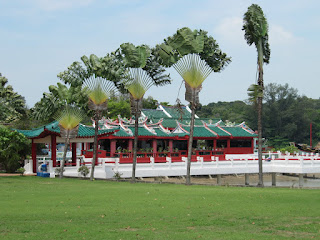

Kusu means “turtle” in Chinese and it got its name from a legend of two sailors, one Malay and one Chinese, who were shipwrecked and rescued by a large turtle who pulled them to the island.
The island is considered sacred to both and both the Malay and Chinese have built a shrine and temple, respectively, on the island. I visited the Chinese temple. At each entrance is a enclosed area that is home to dozens of turtles. A third enclosure is in the center of the island with more turtles. We had over 30 minutes to explore here, and it was relaxing to almost completely encircle the island among the palms, coconut trees, and other vegetation, and watch the large ships sail by.
When we had left the pier, most of the passengers had taken up spots on the deck. We left the island at around 12:30 and at the peak of the sun’s path across the sky – nearly everyone was in the air-conditioned cabin with their cold drinks. Mine was iced green tea. Once we returned to the pier I took advantage of the free shuttle back to the train station.
After lunch, I explored an area called Little India. Words or pictures cannot describe this section of town. Aromas can. As soon as I exited from the train station my nose was overloaded with the scents of incense, spices, jasmine, curry, and food. It was a sensory experience unlike any I can remember. The stores along the main sell clothing, toys, souvenirs, hardware, and all spill out from the store front right up to the curb. So walking down the sidewalk and arcades will take right amongst the goods themselves. A clever way to get you into the store before you realize you are already in the store.
That evening, while walking to dinner, I saw a humorous site. A young woman was walking her tiny little dog down the sidewalk. The young woman was so engrossed in a cell phone conversation that she didn’t notice her poor dog frantically trying to stop and being pulled along with all four legs dragging against the sidewalk and its poor little head almost pulling out of the collar (OK – it wasn’t humorous for the dog). I changed direction to catch up with her and let her know the little dog looked like it was desperate to find a patch of green, but there was no need. When I turned the corner, the woman was off her phone and the little dog looked quite content standing at her side. I guess she wasn’t as engrossed in the phone call as she first appeared.
The next day, I headed over to the Singapore Flyer after another quick coffee shop breakfast (the Starbucks lure won this time). The Flyer is currently the world’s highest Ferris wheel, although the Singaporeans prefer to call it a rotating observation platform. Whatever. It is taller than a 40 story building and takes nearly 40 minutes to make one complete revolution.

The wheel used to rotate counter-clockwise (as you are facing it from the island) until a Feng Shui master persuaded the company to change the direction to clockwise. Throughout the entire ride, the audio-guide explained the Feng Shui elements of the wheel – surrounded by gardens and water, rotating as the sun moves (view of the eat first then the west), and made of metal taken from one of earth’s natural elements. The views were great and you could see much of the south part of the island, the Singapore Straits, and the Indonesian islands in the distance.
On the way back to the hotel, I stopped and visited Chinatown. Most of the island’s population is now Chinese, but it wasn’t always so. This was the area where the Chinese laborers and shops were located in the late 19th and first ½ of the 20th century. The Heritage Center I visited is situated in a restored shop house where scores of Chinese would live and work in unimaginably small and cramped quarters. A 6 foot square room might be the home to a family of 10, or it might be the home and storage area for a worker. They shared a common kitchen which doubled as the toilet, because that was where the water was. It was hard to take in and realize that this was not just a movie but an actual house where people lived and worked and died in such close quarters.
Near the edge of Chinatown was a large Indian temple and th ere was a wedding going on. As I passed by, the wedding party had gathered on the temple steps for video and pictures, and all we passersby were able to smile and wave at the happy scene.
 ere was a wedding going on. As I passed by, the wedding party had gathered on the temple steps for video and pictures, and all we passersby were able to smile and wave at the happy scene.
Such family scenes, even so far from home, are a reminder of what is waiting for me soon.
God bless.
Pictures of the trip are at http://scottshots4.shutterfly.com/593
Monday, April 19, 2010
A bit overwhelmed
Taking a break from my travel journal to share a few feelings from this morning.
I guess it is akin to the proverb, "the straw that broke the camel's back."
Nothing broken, but feeling a bit overwhelmed this morning. While heading in to the office, we passed an accident scene. It is a motorocycle accident and it was a fatality. I do not know anyhting about the victim - male or female, young or old, nationality or religion. All I know is that one more soul has departed this life.
This is the fifth time someone's death has touched me this year. The other four I knew. My cousin Evalee died in January. She knew she was sick for only two months before death overcame her. In late March, a friend from church, Michael, died suddenly from an illness that did not manifest itself until just before he passed away. My uncle George left this earth two weeks ago after a three year illness. And just yesterday, a friend from college, Phil, not a close friend but one whom I had just reconnected with at a reunion in 2009, died in an automobile accident along with his adult daughter.
If you include late last year, this is number six - my father-in-law left to be with the Lord in November - in less than 6 months.
Five I knew. Four I knew pretty well. Three were family.
To all death came in different ways - some watched it steadily, even if quickly, approaching, and for Phil and this morning's stranger death came suddenly and without warning.
I love this life God has given me, I love my wife and family, and God has blessed me with dear friends whom I love as my own family. And in times like today, I dearly miss them.
All this creation belongs to the Lord, and God loves all of His children. Many I have confidence will be with Him after they leave this earth.

This jounal has been in part a way to share my travel experiences, but also in part a way to share what I see God trying to show me about His world.
And the message I hear today is to appreciate what we have been given, be joyful in what we have been given, and let those we love know it.
Love and blessings to all!
I guess it is akin to the proverb, "the straw that broke the camel's back."
Nothing broken, but feeling a bit overwhelmed this morning. While heading in to the office, we passed an accident scene. It is a motorocycle accident and it was a fatality. I do not know anyhting about the victim - male or female, young or old, nationality or religion. All I know is that one more soul has departed this life.
This is the fifth time someone's death has touched me this year. The other four I knew. My cousin Evalee died in January. She knew she was sick for only two months before death overcame her. In late March, a friend from church, Michael, died suddenly from an illness that did not manifest itself until just before he passed away. My uncle George left this earth two weeks ago after a three year illness. And just yesterday, a friend from college, Phil, not a close friend but one whom I had just reconnected with at a reunion in 2009, died in an automobile accident along with his adult daughter.
If you include late last year, this is number six - my father-in-law left to be with the Lord in November - in less than 6 months.
Five I knew. Four I knew pretty well. Three were family.
To all death came in different ways - some watched it steadily, even if quickly, approaching, and for Phil and this morning's stranger death came suddenly and without warning.
I love this life God has given me, I love my wife and family, and God has blessed me with dear friends whom I love as my own family. And in times like today, I dearly miss them.
All this creation belongs to the Lord, and God loves all of His children. Many I have confidence will be with Him after they leave this earth.

This jounal has been in part a way to share my travel experiences, but also in part a way to share what I see God trying to show me about His world.
And the message I hear today is to appreciate what we have been given, be joyful in what we have been given, and let those we love know it.
Love and blessings to all!
Showers and other blessings
The rain has been the main constant for me this week. As I mentioned in a previous note, April isn’t the driest month, but neither is it in the top half of the wettest. Yet we have had rain every day this week. Usually at morning or evening rush hour.
The office is about 17 miles from the hotel. My work day typically begins with an arranged taxi ride from the hotel to the office. We usually leave a little after 7 AM, and arrive pretty consistently about 40 minutes later. The office is on a small island developed as a major industrial center protected heavy military security (think men with big guns and finger on the trigger). Each morning our bags are checked, trunks opened, and IDs scanned in.
Lunch is in the office and usually consists of rice with either a small bit of chicken of fish. Fortunately, one of the employees always brings a supply of fresh fruit, so the meal is capped  with tasty bananas, oranges, mangos, or pineapple. They keep a lot of snacks around the office – cookies, nuts, crackers, and Mentos (the closest thing you will find to chewing gum). They have plenty of coffee and tea available, too, including a version of tea called “Teh Tarik” which is hot tea mixed with condensed milk. It is a bit sweeter than I prefer, but is a quite common after lunch drink and would seem rude to turn it down when someone brings you some every day.
 with tasty bananas, oranges, mangos, or pineapple. They keep a lot of snacks around the office – cookies, nuts, crackers, and Mentos (the closest thing you will find to chewing gum). They have plenty of coffee and tea available, too, including a version of tea called “Teh Tarik” which is hot tea mixed with condensed milk. It is a bit sweeter than I prefer, but is a quite common after lunch drink and would seem rude to turn it down when someone brings you some every day.
 We end the day at 5 PM. Very few people work later than that. Many do not have cars so the office provides shuttles to the nearest bus or train station for their ride to and from work. You miss the bus, you take a taxi which can be difficult to arrange on short notice. My taxi driver also picks me up, as arranged in advance, about the same time. The trip back to the hotel should only take about 45-50 minutes, but if it is raining (which it has nearly every afternoon) the trip is prolonged considerably. Friday night the trip back to the hotel took 1 hour and 45 minutes because of rain, people leaving work a little earlier on Friday, accidents, and what seemed like the entire truck population of the entire island between me and the hotel. As one friend put it perspective when they heard about it, “Why did you go all the way to Singapore for that experience? You could have had that back home.”
On the few days that it did not rain on the way home, it rained while going to or coming from dinner. I haven’t ventured too far from the hotel, but haven’t had to. There are at least four food courts (not like American food courts, but an assortment of different kinds of Asian cuisines) within 5 minutes of the hotel, plus a few American or European chains very near. And Starbucks. There are 4 within a short walk from the hotel and not just little kiosks, but full blown cafes. And there are several other chain coffee houses near as well. This may be tea country but coffee is a power player.
Friday evening I met a co-worker who is from the U.S for dinner. We ate in a popular area called Clarke Quay (pronounced “key”). It runs along the Singapore River and it full of restaurants and cuisines from all over the world (they even have a BK Whopper Bar and McD Café). It is a very popular nightspot for the young and young at heart, and is one of those places that seems to get more crowded the later it gets. When we finished dinner and dessert from an entertaining Greek ice cream stand, it had become very difficult to just walk down the plaza without bumping into someone. This was a bit much for either of us, so we found a relatively quiet café serving cold coffee drinks, and chilled there before heading back to the hotel.
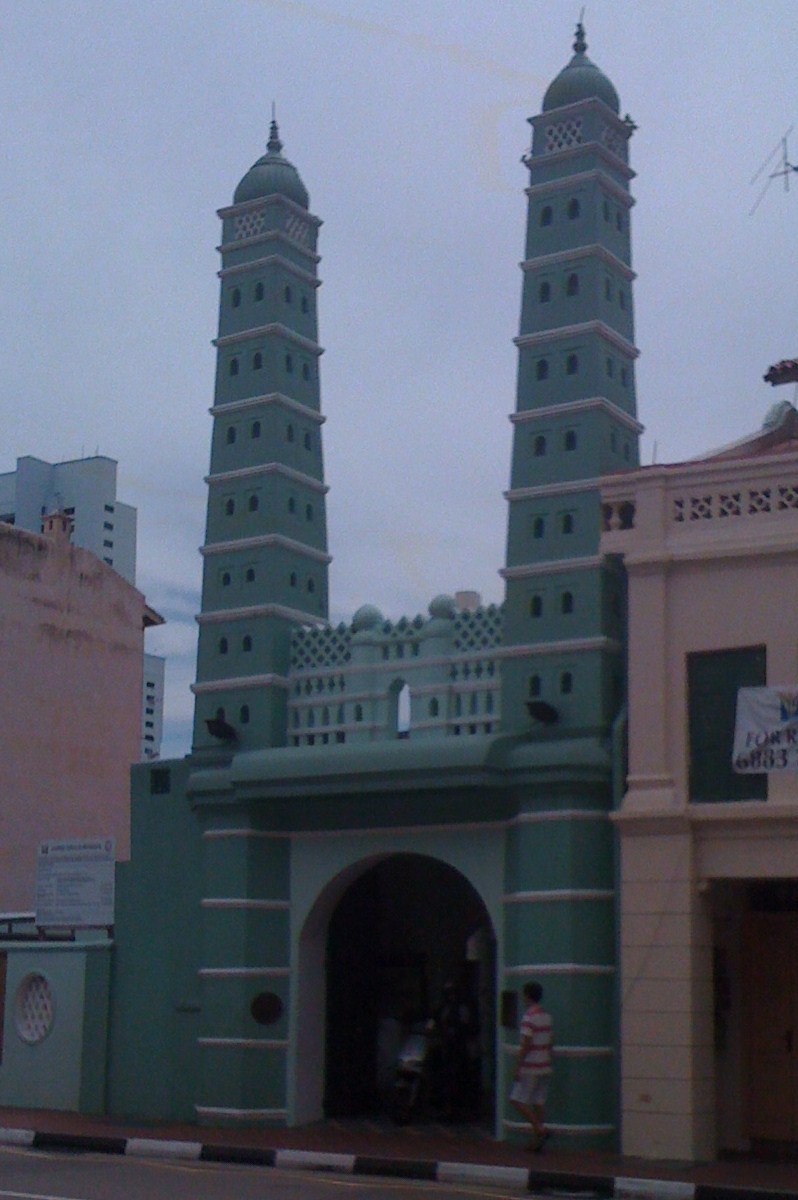
I have been asked about my spiritual perspectives of life here. Like Paul sa id about the
  Athenians in the book of Acts in the Bible, these are a religious people. There are many churches, temples, shrines, and mosques wherever you look. But the religion of many is not of God or of any spiritual being, but is of achieving success in this life (or for just a day). By all measures of this world, they are a very successful people – as successful as any culture in Asia. I cannot see their hearts or their faith, but I wonder what their faith is in? Something here or something greater than here. And I wonder how different we are back home.
 id about the
  Athenians in the book of Acts in the Bible, these are a religious people. There are many churches, temples, shrines, and mosques wherever you look. But the religion of many is not of God or of any spiritual being, but is of achieving success in this life (or for just a day). By all measures of this world, they are a very successful people – as successful as any culture in Asia. I cannot see their hearts or their faith, but I wonder what their faith is in? Something here or something greater than here. And I wonder how different we are back home.
It is a beautiful island and as diverse a culture as nearly any you could ever see. I’ll write later more about what I saw over the weekend.
Pictures of the trip are at http://scottshots4.shutterfly.com/593
Pictures of the trip are at http://scottshots4.shutterfly.com/593
Friday, April 16, 2010
And the forecast calls for…
I like to try to give myself a full 24 hours to help adjust the new time zone when I travel so that I will be better rested before I have to be at work. In this case, since I arrived so early in the morning, I would get a bit longer.
I went back to the hotel to rest a bit and was so tired that I seriously considered just skipping dinner and staying in the hotel the rest of the afternoon and evening. A knock on the door persuaded me otherwise. Housekeeping wanted to come in a freshen up the room, so I headed out for dinner after all.
The next morning – after waking up often during the night – I felt better rested so went for a walk. It was sunny and the sky was cloud free. The Singapore Botanic Gardens are nearby, and that was my destination for the morning. The gardens are over 150 acres and were established in the late 1850s. Much like a public park, the gardens are popular with families on picnics, joggers, walkers (with and without their dogs), photographers, and just people like me who want to explore something different than the routine day-to-day stuff. The park has several distinct sections including a rain forest (making this and Rio de Janeiro, where I have also visited, as the only two major cities in the world with a rain forest fully within the city limits), a tropical stream and ponds, bamboo tree gardens, a large expanse lined with towering palm trees, a ginger garden, a bonsai tree garden, and the star attraction - the National Orchid Garden.
The National Orchid Garden has over 7 acres of gardens featuring over 1000 species of orchids and over 2000 hybrids. It is a color and aroma extravaganza. I must have taken close to a hundred pictures just in this garden. The garden has several special sections for the hybrids, a mist house for one species, an area dedicated to the bromeliad family (most famous member is the pineapple), and my personal favorite, the cool house (air-conditioned to mimic a tropical highland). The pictures on the website at the end of the journal will tell the tale better than my words can.
Part of me wanted to use more of the daylight hours to sight-see, but the goal this weekend was to adjust for the jet-lag and be rested for work. Being out all day in the heat would not have accomplished this. The weekend was a good reminder that activity and rest combined are best for the spirit and body.
The work week had its own adventures, and I’ll write more in that later.
Pictures of the trip are at http://scottshots4.shutterfly.com/593
I mentioned in the last note that we could see lightening from nearby thunderstorms in our last hour approaching Singapore. Being in the tropics (just shy of 2 degrees north of the equator), most of the annual rainfall comes during the northeast monsoon (November to January). They have a second, shorter rainy season in the late summer. April isn’t the driest month of the year, but neither is it in the top 6 wettest months.I headed out of the hotel mid-morning on the say I arrived and found that the thunderstorms I had seen while our flight was approaching Singapore had arrived and it was pouring. If April is supposed to be the beginning of the dry season, what is the wet season like? I had a n umbrella but it didn’t survive the day – my first Singapore purchase was a new umbrella. I spent most of the rest of the morning and early afternoon in one of Singapore’s huge shopping malls and between malls in the underground connectors which are also lined with shops. Walking through the crowded malls can be a challenge as there doesn’t seem to be any predictable pattern to the traffic flow. No semi-organized walk on the right (or on the left) – people just wander, travel in large slowly moving groups, or suddenly change direction or stop when directly in front of you. They are very polite, however, and will always say “Sorry” as you bounce off of them.
 n umbrella but it didn’t survive the day – my first Singapore purchase was a new umbrella. I spent most of the rest of the morning and early afternoon in one of Singapore’s huge shopping malls and between malls in the underground connectors which are also lined with shops. Walking through the crowded malls can be a challenge as there doesn’t seem to be any predictable pattern to the traffic flow. No semi-organized walk on the right (or on the left) – people just wander, travel in large slowly moving groups, or suddenly change direction or stop when directly in front of you. They are very polite, however, and will always say “Sorry” as you bounce off of them.
One mall was adjacent to the convention center which was hosting several weekend events. One event was a Food and Travel show. Admission was free, so all I had to do was wander about and pick which vendor to buy my lunch from. All around me were kiosks hawking and selling Thai, Chinese, Korean, Malay, Indonesian, Japanese, and Indian food, including many, many ways to serve noodles and rice with chicken, pork, or fish.
It had stopped raining by mid-afternoon, so I ventured above ground to Fort Canning Hill. The British fortified this hill near the Singapore River when they first occupied the island. During World War 2, an underground bunker, called the Battle Box, in the center of the fort served as their headquarters during the battle with the Japanese for the island in early 1942. The Japanese took over the bunker after the British surrender in February 1942 and held it until the end of the war. The bunker was sealed up after the war and forgotten until rediscovered in 1988. It has been restored to the way it looked on the day the British decided to surrender, 15th February, 1942. The tour was very moving and each room included animatronics’ re-creations of those last few hours. The door in one room included the phrase, “Last Day” with the date scrawled on the metal by a departing British soldier, and in another room Japanese military notes on the walls could still be seen.
I went back to the hotel to rest a bit and was so tired that I seriously considered just skipping dinner and staying in the hotel the rest of the afternoon and evening. A knock on the door persuaded me otherwise. Housekeeping wanted to come in a freshen up the room, so I headed out for dinner after all.
The next morning – after waking up often during the night – I felt better rested so went for a walk. It was sunny and the sky was cloud free. The Singapore Botanic Gardens are nearby, and that was my destination for the morning. The gardens are over 150 acres and were established in the late 1850s. Much like a public park, the gardens are popular with families on picnics, joggers, walkers (with and without their dogs), photographers, and just people like me who want to explore something different than the routine day-to-day stuff. The park has several distinct sections including a rain forest (making this and Rio de Janeiro, where I have also visited, as the only two major cities in the world with a rain forest fully within the city limits), a tropical stream and ponds, bamboo tree gardens, a large expanse lined with towering palm trees, a ginger garden, a bonsai tree garden, and the star attraction - the National Orchid Garden.
The National Orchid Garden has over 7 acres of gardens featuring over
 1000 species of orchids and over 2000 hybrids. It is a color and aroma extravaganza. I must have taken close to a hundred pictures just in this garden. The garden has several special sections for the hybrids, a mist house for one species, an area dedicated to the bromeliad family (most famous member is the pineapple), and my personal favorite, the cool house (air-conditioned to mimic a tropical highland). The pictures on the website at the end of the journal will tell the tale better than my words can.
I could spent all day here, but it was getting hotter (the heat index – temperature + humidity - was over 105*) and I could almost feel the energy draining out of me. So I grabbed some lunch at the food court (like the Food and Travel Show the day before, these are in all of the malls and features dozens of Asian and a few Western food choices).
Part of me wanted to use more of the daylight hours to sight-see, but the goal this weekend was to adjust for the jet-lag and be rested for work. Being out all day in the heat would not have accomplished this. The weekend was a good reminder that activity and rest combined are best for the spirit and body.
The work week had its own adventures, and I’ll write more in that later.
Pictures of the trip are at http://scottshots4.shutterfly.com/593
Thursday, April 15, 2010
Really up in the air this time
This time I really am on the road.
And the destination this month is Singapore, Singapura, “Lion City”.
And the destination this month is Singapore, Singapura, “Lion City”.
Singapore is just about as far away as you can go from Houston before you are heading back, and the direction I traveled this journey took me by a route as far if not further than I have traveled before in one trip. I left my house last Thursday afternoon, and arrived in my hotel in Singapore 27 hours and nearly 10000 miles later: 21 1/2 hours in the air, 1 1/2 hours on the road, and 4 hours at airports waiting to get back in the air.
I was flying on Singapore Air and the first leg of this trip took me fr om Houston to Moscow. I managed to sleep from somewhere over Canada to somewhere over Norway. We landed in Russia sometime after 2 PM local time. No luck seeing anything of Russia except for our approach over Moscow (didn’t spot any familiar landmarks from the air, but did see quite a few traffic jams on the highways below) and the magnificent views in the airport. Since I bought something at the gift shop and visited the restroom, does that count as a destination?
 om Houston to Moscow. I managed to sleep from somewhere over Canada to somewhere over Norway. We landed in Russia sometime after 2 PM local time. No luck seeing anything of Russia except for our approach over Moscow (didn’t spot any familiar landmarks from the air, but did see quite a few traffic jams on the highways below) and the magnificent views in the airport. Since I bought something at the gift shop and visited the restroom, does that count as a destination?
We re-boarded the same plane about an hour later and soon were off to my eventual destination of Singapore. We flew over southern Russia and Kazakhstan (saw quite a bit of snow still on the ground below) before I fell asleep again. Our flight must have continued west of Tibet, for when I woke up later we were around the northern Pakistan/India border. The ground was ablaze with lights of the cities, towns and highways below, and this was sometime around 2 or 3 AM India time!
As we neared Singapore, the lights below us were from thunderstorms over Malaysia and Indonesia further south.
BTW, Singapore Air lived up to its reputation for magnificent service and food quality. My seat converted to a lay flat seat for sleeping and was wide enough to rest either on my side or back, but surprisingly I did not find the cushion itself as comfortable as on other airlines. But I think I did sleep as well as on other long flights.
We landed around 5:15 AM on Saturday morning and by 5:40 - this is where I find Singapore airport service unmatched anywhere - I was through passport control, picked up my suitcase, retrieved cash from an ATM, visited the Men’s room, and was in a cab for the hotel. Less than 30 minutes from airplane seat to taxi. Amazing!
I arrived at the hotel at 6 AM, and another surprise – my room was ready!! A chance to clean up, unpack, rest a bit, and call home.
Half way around the world and over a day later, and the first thing I do is call home. As much as I enjoy traveling and experiencing new and different cultures, it is home that is always with me. And I am blessed!
More later on experiences in Singapore
Pictures of the trip are at http://scottshots4.shutterfly.com/593
Pictures of the trip are at http://scottshots4.shutterfly.com/593
Wednesday, April 7, 2010
The Somme and the snow
Back in late January and early February, I had the opportunity to travel to France on business. I am back now in the Houston area and trying to get caught up on my journal from this travel back then and tell you a little about the weekend trip I made to northern France while over there.
Back in 2006 I had driven through northern France while traveling between two of our office. I had visited some of the World War 1 sites in southern Belgium, but did not have time to visit the locations in France. While I had been back to France a 2-3 times since, I had not been able to get back to northern France. The last weekend of January, 2010, would be my chance.
And it was forecast to be cold and a chance of freezing rain and snow. Great. I guess if I was going to visit the fields and trenches of one of the bloodiest battles in World War 1, I was going to do it in conditions much like they lived through for 3 ½ years.
I left the office in mid afternoon on Friday so I could get to the hotel before it got dark. I was staying in the community of Albert (pronounced, al-behr’), a small town of about 10,000 in the France region of Picardy. It just about 8 miles north of the Somme River and about 50 miles south of the Belgium border. It was the center of the action between June and November 1915, which is when the primary battles in the Somme were fought. So it was a good central location for me to explore.

My hotel was just off of the main square in town and my room overlooked the square and the church. The moon was full that evening, the evening star near the moon, and both appeared to be near the brightly lit gold statue atop the church steeple.
The next morning was very cold and windy – about 28* F - and I had quite an accumulation of ice on the car. Fortunately the rental car company includes an ice scraper with every rental, but still I cannot recall scraping this much ice off a car since college. I had wanted to explore the past, just not that past.
The roads were clear, so far, and my first stop was about 6 miles north at the Newfoundland Memorial between the villages of Hamel and Beaumont-Hamel. It was on this spot that on the first day of the Battle of the Somme, July 1st, 1915, that the 1st Newfoundland Regiment from Canada moved from there trenches toward the German trenches. In less than 30 minutes, 733 of the 801 men were either dead or wounded. Many never even reached the no-man’s-land between the trenches. The original trenches from both sides are still intact and very little has been done to restore them. The intent is to leave the battlefield as it looked on that tragic day.
I could walk through some of the trenches – boardwalks had been laid down to prevent erosion – but many other locations were still lined with barbed wire and inaccessible. Many of the German trenches are blocked with warning signs, “Danger-Unexploded Ordinance.” Three cemeteries are located on the battlefield, one is a mass grave in a shell crater, where over 700 are buried or commemorated (their bodies have not been found) – nearly 1/3 are unknown graves. In all the Battle of the Somme on this first day, the British Army suffered their worst one-day combat losses in British history, with nearly 20,000 killed and another 40,000 wounded, captured, or missing. The battle lasted until November, and total casualties for the British, French, and Germans were about 1.2 million men. Losses and displacement of the French civilians is unknown.
The weather worsened while I was there and the forecasted snow began to fall – huge flakes and very heavy. For about 30 minutes. And in that brief time, the roads and fields were covered in white.
I drove to two other memorials and several cemeteries. Signs of the battle are still noticeable in places today, even after 95 years. One cemetery is built over many of the tunnels dug for defense. The ground has subsided so much that many of the grave markers are now laid flat because they kept falling over. Near one memorial was the remains of a concrete lined machine gun nest defending the hill side.
Next I stopped at the Thiepval Memorial, built to commemorate almost 73,000 soldiers who died on the Somme bat tlefields between July 1915 and March 1918 who have no known grave. The memorial is the largest British military memorial on the world, and each missing soldier has their name inscribed on the monument. Behind the monument is a small cemetery where 300 French and 300 British are buried, most unknown. The tragic purpose of this site was contrasted by the beauty of the setting and of the snow covered surroundings.
Back in 2006 I had driven through northern France while traveling between two of our office. I had visited some of the World War 1 sites in southern Belgium, but did not have time to visit the locations in France. While I had been back to France a 2-3 times since, I had not been able to get back to northern France. The last weekend of January, 2010, would be my chance.
And it was forecast to be cold and a chance of freezing rain and snow. Great. I guess if I was going to visit the fields and trenches of one of the bloodiest battles in World War 1, I was going to do it in conditions much like they lived through for 3 ½ years.
I left the office in mid afternoon on Friday so I could get to the hotel before it got dark. I was staying in the community of Albert (pronounced, al-behr’), a small town of about 10,000 in the France region of Picardy. It just about 8 miles north of the Somme River and about 50 miles south of the Belgium border. It was the center of the action between June and November 1915, which is when the primary battles in the Somme were fought. So it was a good central location for me to explore.

My hotel was just off of the main square in town and my room overlooked the square and the church. The moon was full that evening, the evening star near the moon, and both appeared to be near the brightly lit gold statue atop the church steeple.
The next morning was very cold and windy – about 28* F - and I had quite an accumulation of ice on the car. Fortunately the rental car company includes an ice scraper with every rental, but still I cannot recall scraping this much ice off a car since college. I had wanted to explore the past, just not that past.
The roads were clear, so far, and my first stop was about 6 miles north at the Newfoundland Memorial between the villages of Hamel and Beaumont-Hamel. It was on this spot that on the first day of the Battle of the Somme, July 1st, 1915, that the 1st Newfoundland Regiment from Canada moved from there trenches toward the German trenches. In less than 30 minutes, 733 of the 801 men were either dead or wounded. Many never even reached the no-man’s-land between the trenches. The original trenches from both sides are still intact and very little has been done to restore them. The intent is to leave the battlefield as it looked on that tragic day.
I could walk through some of the trenches – boardwalks had been laid down to prevent erosion – but many other locations were still lined with barbed wire and inaccessible. Many of the German trenches are blocked with warning signs, “Danger-Unexploded Ordinance.” Three cemeteries are located on the battlefield, one is a mass grave in a shell crater, where over 700 are buried or commemorated (their bodies have not been found) – nearly 1/3 are unknown graves. In all the Battle of the Somme on this first day, the British Army suffered their worst one-day combat losses in British history, with nearly 20,000 killed and another 40,000 wounded, captured, or missing. The battle lasted until November, and total casualties for the British, French, and Germans were about 1.2 million men. Losses and displacement of the French civilians is unknown.
The weather worsened while I was there and the forecasted snow began to fall – huge flakes and very heavy. For about 30 minutes. And in that brief time, the roads and fields were covered in white.
I drove to two other memorials and several cemeteries. Signs of the battle are still noticeable in places today, even after 95 years. One cemetery is built over many of the tunnels dug for defense. The ground has subsided so much that many of the grave markers are now laid flat because they kept falling over. Near one memorial was the remains of a concrete lined machine gun nest defending the hill side.
Next I stopped at the Thiepval Memorial, built to commemorate almost 73,000 soldiers who died on the Somme bat
 tlefields between July 1915 and March 1918 who have no known grave. The memorial is the largest British military memorial on the world, and each missing soldier has their name inscribed on the monument. Behind the monument is a small cemetery where 300 French and 300 British are buried, most unknown. The tragic purpose of this site was contrasted by the beauty of the setting and of the snow covered surroundings.
I stopped back in Albert for a visit to their World War 1 museum housed in tunnels beneath the city streets. The museum is normally closed until after the winter, but I had contacted them in advance and found out a British school group was to visit on this day and I was welcome to join them. Turns out this school group had just been at Thiepval the same time I was there, and one of the parent sponsors and I joked about who was following who. It was fun watching the kids on this field trip. In many ways, not any different from field trips I had when I was there age or those of my children. Some kids poured over the information and exhibits and took careful notes, and for some it was just a fun time to run up and down the tunnels with only an occasional glance at the artifacts around them. The museum specializes in recreating life in the World War 1 trenches, and includes a great deal of items excavated from the surrounding battlefields. Not just weapons, but everyday things like glassware, cards, pictures from home, and items handcrafted from war leftovers like shell casings. Things like crosses made from weapons.
Before it got dark I ventured out for a bit more driving, and the roads, parking areas, and pathways were starting to get icy. Just north of Albert is two interesting sites. First is the village of Pozieres, famous as it was near here that tanks were first used in battle in September 1916. They really ready for use in battle yet, and less than half of those deployed actually made to the German lines. But it was here that tank warfare began.
Not far from this monument is the village of La Boisselle, which was located on the German front lines on July 1st 1915. On that morning, nearly 27 tons of explosives were detonated from a tunnel dug beneath the front lines. The resulting explosion left a crater 90 feet deep and 300 feet across and sent debris almost 4000 feet into the air. Over 2500 British casualties were suffered in the attack. No one knows how many Germans died and many are presumed buried beneath the crater. Memorial crosses have been placed in the bottom of the crater. The body of one of the missing British soldiers was found at the edge of the crater 82 years after he died.
The next morning, after more practice at ice-scraping, I headed out to visit a few more sites before heading back to Le Havre. Three sites I stopped at on the way were connected to the famous German aviator, the Red Baron, Manfred von Richthofen. In the last months of the war, the Somme region was still divided between the British and French forces, and the Germans. Aviators from both sides would fly over the opponents’ lines to observe military actions, to bomb or fire on the troops, or to engage the planes from the other side. In April 1918, Richthofen was based along the Somme and set up on the morning of the April 21st for a patrol. His flyers and British flyers engaged over the river near the village of Vaux-sur-Somme and during the aerial battle, he was hit and crash landed behind the Australian lines (the most likely scenario was he was hit by a bullet fired from a ground based Australian machine gunner). He was dead in seconds after crash landing, and was buried not far from the battlefield in the village cemetery of Bertangles. After the war, he was move to a German military cemetery near the Somme village of Fricourt, only later to be moved twice more to burial sites in Germany. I visited the three France sites at Bertangles, Fricourt and his crash landing site near Vaux-sur-Somme
The drive back was uneventful until I was less than 30 minutes from the hotel. It began to snow again and more heavily than at any time during the weekend. The expressway was almost completely covered, and snowplows had been dispatched on the lanes heading the opposite direction (I guess that side because it was uphill). I stopped at a roadside park for a few minutes while the snow tapered off, took a few more pictures of the snow covered countryside, then headed back to the hotel.

Later I was thinking on the snow and the battlefields. How a region so scarred by death and violence could look so beautiful and pure by a layer of snow. Kind of like mercy, but instead of snow just covering up the scars, mercy actually heals.
Pictures of the trip are at http://scottshots4.shutterfly.com/479
Before it got dark I ventured out for a bit more driving, and the roads, parking areas, and pathways were starting to get icy. Just north of Albert is two interesting sites. First is the village of Pozieres, famous as it was near here that tanks were first used in battle in September 1916. They really ready for use in battle yet, and less than half of those deployed actually made to the German lines. But it was here that tank warfare began.
Not far from this monument is the village of La Boisselle, which was located on the German front lines on July 1st 1915. On that morning, nearly 27 tons of explosives were detonated from a tunnel dug beneath the front lines. The resulting explosion left a crater 90 feet deep and 300 feet across and sent debris almost 4000 feet into the air. Over 2500 British casualties were suffered in the attack. No one knows how many Germans died and many are presumed buried beneath the crater. Memorial crosses have been placed in the bottom of the crater. The body of one of the missing British soldiers was found at the edge of the crater 82 years after he died.
The next morning, after more practice at ice-scraping, I headed out to visit a few more sites before heading back to Le Havre. Three sites I stopped at on the way were connected to the famous German aviator, the Red Baron, Manfred von Richthofen. In the last months of the war, the Somme region was still divided between the British and French forces, and the Germans. Aviators from both sides would fly over the opponents’ lines to observe military actions, to bomb or fire on the troops, or to engage the planes from the other side. In April 1918, Richthofen was based along the Somme and set up on the morning of the April 21st for a patrol. His flyers and British flyers engaged over the river near the village of Vaux-sur-Somme and during the aerial battle, he was hit and crash landed behind the Australian lines (the most likely scenario was he was hit by a bullet fired from a ground based Australian machine gunner). He was dead in seconds after crash landing, and was buried not far from the battlefield in the village cemetery of Bertangles. After the war, he was move to a German military cemetery near the Somme village of Fricourt, only later to be moved twice more to burial sites in Germany. I visited the three France sites at Bertangles, Fricourt and his crash landing site near Vaux-sur-Somme
The drive back was uneventful until I was less than 30 minutes from the hotel. It began to snow again and more heavily than at any time during the weekend. The expressway was almost completely covered, and snowplows had been dispatched on the lanes heading the opposite direction (I guess that side because it was uphill). I stopped at a roadside park for a few minutes while the snow tapered off, took a few more pictures of the snow covered countryside, then headed back to the hotel.
Later I was thinking on the snow and the battlefields. How a region so scarred by death and violence could look so beautiful and pure by a layer of snow. Kind of like mercy, but instead of snow just covering up the scars, mercy actually heals.
Pictures of the trip are at http://scottshots4.shutterfly.com/479
Tuesday, April 6, 2010
Seeing and reading the finer points
Back in late January and early February, I had the opportunity to travel to France on business. I am back now in the Houston area and trying to get caught up on my journal from this travel back then.
My co-worker and I had quite a busy week – so busy that the time we spent trying to set up a daily agenda went for naught as we constantly had to adapt our meeting schedule as unexpected changes and conflicting meetings came up. It pays to be flexible when working with many different people in a short time frame.
At the end of the first day, we were taken to dinner along with the team we were working with. My co-worker could not read any French, and while my reading ability is a long way from fluent, it is usually passable in reading a menu. However, while summarizing the choices for my co-worker, one of the French managers laughingly warned me to not summarize the menu too much because I might skip over a key element in the dish – either in an ingredient or in the way it was prepared. This was a lesson I learned the hard way a week later.
I was on my own for dinner and stopped at a place I had dined at before that I seemed to recall had good veal. So I sat down and looked over the menu, scanning for key words to indicate what the dish was. I should have scanned more words a bit more closely. My first course, the appetizer, included what I thought it had – smoked salmon, but also included a healthy portion of tuna tartar – raw tuna. Things went from unexpected to unbelievable. My main course was veal, but once again I had missed a key word. Instead of a nice serving of breaded or grilled veal, I had tete d’veau: “Calf’s Head!” The cheese plate and dessert were neither what I thought I had ordered, but turned out to be very pleasant and tasty surprises. And after the main course surprise, I needed something tasty and filling. Lesson learned, mon ami!
Sometimes, struggling with the language or pronunciation can be a good dice-breaker and entertaining. One café that I have enjoyed many times has a particularly good salad that I order each time. And I never can pronounce it correctly. I have had the same waiter each visit and he is always trying to help me pronounce the salad the correct way. It is an enjoyable exercise. I like the friendliness as well as the food at this café. One evening after we paid the bill and left, walking back through the rain to the hotel, we heard someone calling after us. Turning around, we saw the owner running down the street toward us. She had accidently overcharged us by 4 Euros and was trying to return it to us. I can’t remember that ever happening anywhere else I have eaten before – anywhere!
Lunches during the work week are on the plant property. This being a hazardous work location we need to wear protective shoes, coats, hard hats and eye protection while transversing the grounds. In some areas you either have to wear a gas detector or be with someone who has one. However, once in the lunch room all of the protective equipment comes off and the result is a visual disconnect. Imagine a petite young woman, light hair, pretty face, and colorful sweater. Now picture this same woman blending right in among her male co-workers in a sea of heavy blue overcoats, protective pants, heavy steel-toed shoes, white hard hat, and safety goggles. Safety is the great equalizer of appearances. Here I am in my safety helmet and goggles (visitors get blue).

Unlike the November 2009 trip, we elected to get our own car. It has its advantages. But knowing some French, and paying attention to the maps or GPS is important. While leaving the airport the day we arrived, I exited too soon off of the main highway. The exit signs “said” it was the way to go, but I had driven this route before and should have known better. It worked out OK and we had a quick tour through the Paris suburb of Neuilly. The next day, the main road we were driving on was closed and so I had to manage the detour route and all detour signs were in French, of course. All I had to do was keep the Channel on my right. One morning, I took a different route to the plant because it was a little quicker, and so that my co-worker could have a change of scenery. But the drawbridge was up for a passing barge. We got the change of scenery, but it was not quicker. And finally on the day I was returning to the airport, I misread the exit sign (and again I should have known better as I had driven this route many times), and could NOT get back to the main road. I spent the next ½ hour circling the airport on the service roads that are there for airport employees and access to the surrounding support facilities. Go ahead. Smile. I got lost. It wasn’t funny at the time.
It was an interesting two weeks – and learning to see the bigger picture in the language, following directions, and appearances.
It was very cold and wet during the first week, and the forecast for the weekend included chances of snow.
I’ll write more later about my mid-trip weekend and how well this chance played out.
Pictures of the trip are at http://scottshots4.shutterfly.com/479
My co-worker and I had quite a busy week – so busy that the time we spent trying to set up a daily agenda went for naught as we constantly had to adapt our meeting schedule as unexpected changes and conflicting meetings came up. It pays to be flexible when working with many different people in a short time frame.
At the end of the first day, we were taken to dinner along with the team we were working with. My co-worker could not read any French, and while my reading ability is a long way from fluent, it is usually passable in reading a menu. However, while summarizing the choices for my co-worker, one of the French managers laughingly warned me to not summarize the menu too much because I might skip over a key element in the dish – either in an ingredient or in the way it was prepared. This was a lesson I learned the hard way a week later.
I was on my own for dinner and stopped at a place I had dined at before that I seemed to recall had good veal. So I sat down and looked over the menu, scanning for key words to indicate what the dish was. I should have scanned more words a bit more closely. My first course, the appetizer, included what I thought it had – smoked salmon, but also included a healthy portion of tuna tartar – raw tuna. Things went from unexpected to unbelievable. My main course was veal, but once again I had missed a key word. Instead of a nice serving of breaded or grilled veal, I had tete d’veau: “Calf’s Head!” The cheese plate and dessert were neither what I thought I had ordered, but turned out to be very pleasant and tasty surprises. And after the main course surprise, I needed something tasty and filling. Lesson learned, mon ami!
Sometimes, struggling with the language or pronunciation can be a good dice-breaker and entertaining. One café that I have enjoyed many times has a particularly good salad that I order each time. And I never can pronounce it correctly. I have had the same waiter each visit and he is always trying to help me pronounce the salad the correct way. It is an enjoyable exercise. I like the friendliness as well as the food at this café. One evening after we paid the bill and left, walking back through the rain to the hotel, we heard someone calling after us. Turning around, we saw the owner running down the street toward us. She had accidently overcharged us by 4 Euros and was trying to return it to us. I can’t remember that ever happening anywhere else I have eaten before – anywhere!
Lunches during the work week are on the plant property. This being a hazardous work location we need to wear protective shoes, coats, hard hats and eye protection while transversing the grounds. In some areas you either have to wear a gas detector or be with someone who has one. However, once in the lunch room all of the protective equipment comes off and the result is a visual disconnect. Imagine a petite young woman, light hair, pretty face, and colorful sweater. Now picture this same woman blending right in among her male co-workers in a sea of heavy blue overcoats, protective pants, heavy steel-toed shoes, white hard hat, and safety goggles. Safety is the great equalizer of appearances. Here I am in my safety helmet and goggles (visitors get blue).

Unlike the November 2009 trip, we elected to get our own car. It has its advantages. But knowing some French, and paying attention to the maps or GPS is important. While leaving the airport the day we arrived, I exited too soon off of the main highway. The exit signs “said” it was the way to go, but I had driven this route before and should have known better. It worked out OK and we had a quick tour through the Paris suburb of Neuilly. The next day, the main road we were driving on was closed and so I had to manage the detour route and all detour signs were in French, of course. All I had to do was keep the Channel on my right. One morning, I took a different route to the plant because it was a little quicker, and so that my co-worker could have a change of scenery. But the drawbridge was up for a passing barge. We got the change of scenery, but it was not quicker. And finally on the day I was returning to the airport, I misread the exit sign (and again I should have known better as I had driven this route many times), and could NOT get back to the main road. I spent the next ½ hour circling the airport on the service roads that are there for airport employees and access to the surrounding support facilities. Go ahead. Smile. I got lost. It wasn’t funny at the time.
It was an interesting two weeks – and learning to see the bigger picture in the language, following directions, and appearances.
It was very cold and wet during the first week, and the forecast for the weekend included chances of snow.
I’ll write more later about my mid-trip weekend and how well this chance played out.
Pictures of the trip are at http://scottshots4.shutterfly.com/479
Monday, April 5, 2010
France...again... ;-)
Sitting at my computer at my home in Sugar Land as I write this. I am trying to get caught up on my travel journals from a trip to France earlier this year, and do so before my next trip later this month. The events in this journal take place between January 23rd and January 24th. Tic-toc...
I was fortunate to be able to reschedule a trip to France in the winter of 2010. I was accompanied on this return trip by a peer from another office who would help me with my work.
I took some cold medication during the flight as I was trying to shake off the effects or a cough I had most of the month. The medication helped me sleep during the flight, but left me a bit groggy the last hour or two of the flight. Cold water in the face and good coffee down the hatch helped quite a bit.
This was not my first to Paris by a long shot, but it was my first trip to the older terminal, T-1, at the Charles de Gaulle airport near Paris. The airport terminal is donut shaped built around a ground to roof atrium. Secure access from one floor to the next is by people movers enclosed within plexiglass tubes. The airplanes do not come right up to the terminal but the gates are located in satellites connected to the terminal by underground people-movers. The entire set-up leaves one with the impression of being a human hamster inside a giant hamster cage.
It was raining when we left the airport (same song, different verse?), but we made good time and arived in Le Havre just a little over two hours, including a stop for coffee and a snack.
My co-worker had never been to France before and his father had served in WW2 in Europe, so we headed out to Normandy the next day. I had been to the Normandy battlefields twice before, so I gave him my own best of Normandy tour (or as they say in translated French, “Beaches of Disembarkation.” We visited the Pegasus Bridge, location where British gliders landed and captured the bridge of D-Day, drove along the British landing sites, and stopped at Arromanches, location of the man-made harbor used during the first months of the invasion, and a German battery silenced during D-Day (and featured in the initial scenes of “The Longest Day” movie where the Germans watched the incoming Allied ships). We also stopped at the American Cemetery at Omaha Beach. The cemetery has a visitor center built for the 60th anniversary of D-Day. The museum includes a moving film about some of the soldiers buried in the Cemetery (or in one case, memorialized on the “Wall of the Missing”) where surviving family and friends talk about the soldier’s life as they were growing up, just before they left for Europe, or their last letters home. Each story ended with a view of their grave site.
The sun came out as we walked among the Crosses and Stars of David. We walked down a trail to the beach itself, where some of the largest number of casualties took place. While walking along, a family with young chi ldren also walked past. One young boy playfully tossed seashells into the surf, and drew pictures in the sand. As I watched the peaceful scene before me I thought, “Does this young boy know the story of this beach? Does he know the blood that was shed here in violence so that he could play in peace?” It is a story I hope no one forgets so it won’t have to happen again.
I’ll write more later about the work week and my mid-trip weekend.
Pictures of the trip are at http://scottshots4.shutterfly.com/479
I was fortunate to be able to reschedule a trip to France in the winter of 2010. I was accompanied on this return trip by a peer from another office who would help me with my work.
I took some cold medication during the flight as I was trying to shake off the effects or a cough I had most of the month. The medication helped me sleep during the flight, but left me a bit groggy the last hour or two of the flight. Cold water in the face and good coffee down the hatch helped quite a bit.
This was not my first to Paris
 by a long shot, but it was my first trip to the older terminal, T-1, at the Charles de Gaulle airport near Paris. The airport terminal is donut shaped built around a ground to roof atrium. Secure access from one floor to the next is by people movers enclosed within plexiglass tubes. The airplanes do not come right up to the terminal but the gates are located in satellites connected to the terminal by underground people-movers. The entire set-up leaves one with the impression of being a human hamster inside a giant hamster cage.
It was raining when we left the airport (same song, different verse?), but we made good time and arived in Le Havre just a little over two hours, including a stop for coffee and a snack.
My co-worker had never been to France before and his father had served in WW2 in Europe, so we headed out to Normandy the next day. I had been to the Normandy battlefields twice before, so I gave him my own best of Normandy tour (or as they say in translated French, “Beaches of Disembarkation.” We visited the Pegasus Bridge, location where British gliders landed and captured the bridge of D-Day, drove along the British landing sites, and stopped at Arromanches, location of the man-made harbor used during the first months of the invasion, and a German battery silenced during D-Day (and featured in the initial scenes of “The Longest Day” movie where the Germans watched the incoming Allied ships). We also stopped at the American Cemetery at Omaha Beach. The cemetery has a visitor center built for the 60th anniversary of D-Day. The museum includes a moving film about some of the soldiers buried in the Cemetery (or in one case, memorialized on the “Wall of the Missing”) where surviving family and friends talk about the soldier’s life as they were growing up, just before they left for Europe, or their last letters home. Each story ended with a view of their grave site.
The sun came out as we walked among the Crosses and Stars of David. We walked down a trail to the beach itself, where some of the largest number of casualties took place. While walking along, a family with young chi
 ldren also walked past. One young boy playfully tossed seashells into the surf, and drew pictures in the sand. As I watched the peaceful scene before me I thought, “Does this young boy know the story of this beach? Does he know the blood that was shed here in violence so that he could play in peace?” It is a story I hope no one forgets so it won’t have to happen again.
I’ll write more later about the work week and my mid-trip weekend.
Pictures of the trip are at http://scottshots4.shutterfly.com/479
Rain and mercy flowed down
I am still here in Sugar Land as I write this, but have another trip coming up soon. I need to complete my journal from my trip to France in October/November in 2009 (and also post the journals from another trip back in the winter of 2010).
I wrote previously that Cafes are a part of the French culture, and the presence of some dogs with their masters in these dining establishments is a given. One evening I dined at a bright and cheery looking place near the hotel. It must be very popular with famous French guests, for the placemats included “rave reviews” by some of the more well-known visitors. The only name I recognized was that of Sophie Marceau (who played the French born English Queen in “Braveheart”) who had eaten here on June 28, 2001. Near my table was a large “Marley” type dog (Labrador Retriever) who lay quietly by the bar the entire evening. Some things you just will never see in an American restaurant.
The weather was wet and I must have still been a bit jet-lagged as the work week began. I arrived at the front gate of our plant and was allowed to go ahead and make my way in the rain to the main office area. I got there and my contact was not around. Seemed I had completely forgotten about a meeting he had invited me to attend with him in another part of the plant. So back out in the rain I went to another building. So now I am tired and very wet.
Rain seemed to be the theme of the week and it was raining everyday – some days very hard – of the week. This significantly impacted my travel plans later.
The work week consisted mostly of meetings and developing an action plan for future work for the personnel I was meeting with.
The evenings consisted of dining alone at the nearby restaurants. Having been to Le Havre a few times before this trip, I decided to try to dine at places I had not been before rather than my favorites. Two reasons contributed to this. First, I wanted to experience more of the culture and foods recommended by the hotel staff and those in the office. Second, many of my favorites weren’t there anymore! One evening, I had walked down the ocean front because I knew there several small cafes there where I could get a quick meal (and quick can be important as a typical French dinner can last 2-3 hours). Boy was I shocked when I got the ocean front park and not only were the cafes not open, they were GONE! I am not talking about boarded up, but just not there. These places are seasonal cafes, open only from March until October, and are portable. So much for quick, unless I settled for French version of Domino’s pizza or Subway.
I wrote previously that Cafes are a part of the French culture, and the presence
 of some dogs with their masters in these dining establishments is a given. One evening I dined at a bright and cheery looking place near the hotel. It must be very popular with famous French guests, for the placemats included “rave reviews” by some of the more well-known visitors. The only name I recognized was that of Sophie Marceau (who played the French born English Queen in “Braveheart”) who had eaten here on June 28, 2001. Near my table was a large “Marley” type dog (Labrador Retriever) who lay quietly by the bar the entire evening. Some things you just will never see in an American restaurant.
 The rain continued to wreck havoc on the week, and this was complicated by traffic problems reminiscent of home – road construction and trains. One morning, I left in a taxi for the office in a very heavy rain. Traffic was snarled some minor street flooding and it was the first day of school after a winter break, so lots of Mom’s and Dad’s driving their kids to school. As we neared the canal we have to cross to get to the office, the driver noticed the drawbridge across the canal was closed for repairs (this is not a very big town – you’d think the taxi drivers in the area would know what bridges were open and which were closed), so we had to double back through the school zone and water logged streets to another bridge. But that route was blocked by not one but TWO trains. Then when we moved on past the train tracks, the traffic was moving very slowly because ½ the road was closed for construction. Finally, what should have been a 20 minute drive took almost three times as long. Some things you will always see in and out of America.
The day did not end well, either. My wife’s father had been ill for several weeks before this trip. In fact, the trip almost didn’t even happen because of the seriousness of his condition. But just a few days before I was to leave, he started showing signs of improvement. However, five days into this trip, my wife called me one evening and said things weren’t looking good. We were still hopeful and prayerful he would get better because he had rebounded already several times before. This very rainy and hectic day ended with my wife calling me late in the French afternoon to tell me that her Daddy had gone to be with the Lord.
It was too late to try to get my flight plans changed and arrange for last minute transportation during the evening back to Paris, so I planned for Friday to be the travel day to get back to Paris and the airport. Then the rain impacted my plans again. I went to the train station that next morning to catch the first train possible back to Paris. When I arrived I could tell this was not a normal day for train trips to Paris or anywhere from Le Havre. The steady and heavy rain all week had caused overnight mudslides and flooding on the tracks just south west of Le Havre and al train service was stopped indefinitely. I called the office and they made arrangements for a shuttle to take me back to Paris, but it would not be available to leave until nearly lunch time. So I waited. And fretted. And realized there wasn’t much to do but trust it would all work out. In hindsight, things worked out as well as they could have. Had my father-in-law died just one day later, I might have been away from the office for the weekend with my luggage in storage in a different town than I as in. Had I been able to changes my flight to Friday instead of Saturday, the terrible weather might have prevented me from catching the flight.
 As it turned out, God in his mercy allowed for things to work out in a more relaxing manner than I could have expected. I was able to arrive in Paris in the late afternoon – with all of my luggage and with the weather clearing up - and relax for a few hours. I was able to appreciate in ways I have seldom had the chance to appreciate before, the beauty of the changing leaves in the Paris parks; two people in love taking each other’s pictures in the park; shopping for gifts for the people I love whom God had blessed me with; and the beauty of a man-made structure built and dedicated to God’s glory, Notre Dame.
 As it turned out, God in his mercy allowed for things to work out in a more relaxing manner than I could have expected. I was able to arrive in Paris in the late afternoon – with all of my luggage and with the weather clearing up - and relax for a few hours. I was able to appreciate in ways I have seldom had the chance to appreciate before, the beauty of the changing leaves in the Paris parks; two people in love taking each other’s pictures in the park; shopping for gifts for the people I love whom God had blessed me with; and the beauty of a man-made structure built and dedicated to God’s glory, Notre Dame.
 I was grieving, but refreshed.
Pictures of the trip are at http://scottshots4.shutterfly.com/424
Thursday, March 4, 2010
Rainy Day in Rouen
It seems my previous post was a little misleading. I am NOT currently in France, but I was back in October/November in 2009. I am currently home in the Houston area and just trying to get caught up on previous trips. I think I mentioned that somewhere, but should have been more clear.
I know I mentioned arriving in France in late October while fighting a head cold and nursing a strained elbow tendon. I think I forgot to mention I was also recovering from a sprained ankle suffered back in October in Texas. And the weather was cool and wet. Not conducive to either a cold or to achy joints.
I decided to spend the rest of my weekend in Rouen, about 30 minutes east of Le Havre by train. Rouen is a very old city, dating back to the Roman times, and has sometimes been a regional capital and always one of the predominant cities of Normandy. One thousand years ago it was the 2nd largest city in France after Paris. William the Conqueror made the city his home, so for many years it was as important to the English as to the French. In the 20th century Rouen was devastated by Allied bombings during the WW2 Battle of Normandy, and while most of the historic center of the city survived, you can still see battle damage on some of the old buildings today.
It was raining quite hard when the train arrived in Rouen and kept up most of the morning. Even with an umbrella in hand, my clothes were quite wet by the time I made it to my first destination. The train station is uphill from the center of town, so the walk to the center is an easy 20 minutes or so.
Very near the train station is the tower where Joan of Arc was imprisoned in 1431. This tower is the only thing left of the old city wall that at one time surrounded Rouen, and Joan (in French, Jeanne d'Arc) was kept here during her trial and before her execution by the English. She was officially tried for being a witch (she claimed to have heard the saints speaking to her to lead the French armies), but it seems more likely the English used this charge as an excuse for why they kept losing battles to an army being led by a 19 year old girl. As if to atone for their complicity in her execution, Joan is revered throughout the city (and is considered a saint herself by the Catholic Church).
The place where Joan was executed was the town square and is now the site for the city market and a 20th century church building. The place where she was burned at the stake is now a lovely flower garden adjacent to the church building and the square.
I stopped for lunch at a restaurant near the church. Morning services had just let out and the place was very busy with the after-church crowd. Seems things are the same here as back home with popular eating places crowded for lunch after Sunday morning church services. Lunch is a very important time everyday in Rouen, and nearly all sights are closed from Noon until 2 PM.
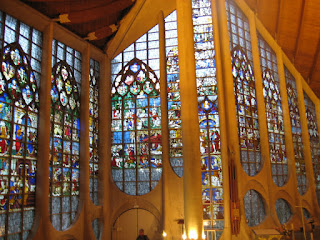
After lunch (and after things reopened at 2 PM) I went back inside the Jeanne d'Arc Church. It is built to resemble more of a Norse ship than a traditional church shape, but is decorated with the stained glass salvaged from a 16th century church destroyed in WW2. The modern sanctuary seemed alive with the color of the light filtering through the glass. It was a great blend of old and modern.
A short distance down the street is the Gros Horloge, or Big Clock. The 16th century clock is set in a archway over the street, but the clockworks are in a tower next to the arch and several stories above. While not a unique configuration, it is unusual because of the distance between the clock face and the clock works (about 3-4 stories), and because this one still works after nearly 5 centuries. The clock only has an hour hand, but in the Renaissance you didn't anything more specific that that. Try having a meeting today based on an hour hand only clock. From the top of the bell tower (where the bells and the clock works are kept), I had a fine view of Rouen and fortunately it had quit raining.
Leaving the Big Clock, I walked past the Palace of Justice which still bears the battle scars in its walls from WW2 bombings.
For my Texas and Louisiana readers, nearby the Palace I spotted a plaque marking the birthplace of René-Robert Cavelier, Sieur de La Salle. He was the Frenchman who explored the Great Lakes and Mississippi River, and claimed the entire watershed of the Mississippi for his king, Louis 14th, the Sun King. Later when he tried to return and colonize the mouth of the Mississippi, he overshot and landed in Texas. He put his colony there, but three years later he was killed and the colony dissolved. Anyway, I saw his birthplace in Rouen.
A short distance later I reached the Notre-Dame Cathedral. No not THAT Notre Dame, but one almost as famous (on a side note, it seems nearly every town of significant size has a Notre Dame Cathedral - "Our Lady" as Mary the mother of Jesus is called, is the patron of France). This is the cathedral made famous by the Impressionist artist Claude Monet who did around 30 separate paintings of the front of the Gothic cathedral in the 1890s. Inside the Cathedral are a few tombs, including that of the heart of Richard the Lion-Hearted, King of England. Why is the King of England's heart buried in France (I left my my heart, in Rouen)? He was the great-great grandson of William the Conqueror, and Rouen was where Richard considered home. Richard the Lionhearted was more French than English, or to put it in today's perspective, Richard was less Sean Connery and more Jean Reno.
My last stop on my walk (because by then the tender ankle was really bothering me) was at the site of St. Maclou plague cemetery. The cemetery was created during the great plague in the mid 14th century, which killed nearly 2/3 of the Rouen population. In the early 16th century the courtyard was built to house the exhumed bones on the upper floors. Carvings were added on all the columns of the surrounding courtyard depicting skulls and bones and other images of death. At one point, a cat was buried in the walls to scare off evil spirits. It was later found and is now on display in a glass case in the wall. Nice kitty.
I made my way back to the train station for the 30 minute ride back to Le Havre. It was dark by the time I got to the hotel.
Later, I will describe the work week and the unforeseen ending of the trip.
Pictures of this day and the rest of the trip are at http://scottshots4.shutterfly.com/424
I know I mentioned arriving in France in late October while fighting a head cold and nursing a strained elbow tendon. I think I forgot to mention I was also recovering from a sprained ankle suffered back in October in Texas. And the weather was cool and wet. Not conducive to either a cold or to achy joints.
I decided to spend the rest of my weekend in Rouen, about 30 minutes east of Le Havre by train. Rouen is a very old city, dating back to the Roman times, and has sometimes been a regional capital and always one of the predominant cities of Normandy. One thousand years ago it was the 2nd largest city in France after Paris. William the Conqueror made the city his home, so for many years it was as important to the English as to the French. In the 20th century Rouen was devastated by Allied bombings during the WW2 Battle of Normandy, and while most of the historic center of the city survived, you can still see battle damage on some of the old buildings today.
It was raining quite hard when the train arrived in Rouen and kept up most of the morning. Even with an umbrella in hand, my clothes were quite wet by the time I made it to my first destination. The train station is uphill from the center of town, so the walk to the center is an easy 20 minutes or so.
Very near the train station is the tower where Joan of Arc was imprisoned in 1431. This tower is the only thing left of the old city wall that at one time surrounded Rouen, and Joan (in French, Jeanne d'Arc) was kept here during her trial and before her execution by the English. She was officially tried for being a witch (she claimed to have heard the saints speaking to her to lead the French armies), but it seems more likely the English used this charge as an excuse for why they kept losing battles to an army being led by a 19 year old girl. As if to atone for their complicity in her execution, Joan is revered throughout the city (and is considered a saint herself by the Catholic Church).
The place where Joan was executed was the town square and is now the site for the city market and a 20th century church building. The place where she was burned at the stake is now a lovely flower garden adjacent to the church building and the square.
I stopped for lunch at a restaurant near the church. Morning services had just let out and the place was very busy with the after-church crowd. Seems things are the same here as back home with popular eating places crowded for lunch after Sunday morning church services. Lunch is a very important time everyday in Rouen, and nearly all sights are closed from Noon until 2 PM.

After lunch (and after things reopened at 2 PM) I went back inside the Jeanne d'Arc Church. It is built to resemble more of a Norse ship than a traditional church shape, but is decorated with the stained glass salvaged from a 16th century church destroyed in WW2. The modern sanctuary seemed alive with the color of the light filtering through the glass. It was a great blend of old and modern.
A short distance down the street is the Gros Horloge, or Big Clock. The 16th century clock is set in a archway over the street, but the clockworks are in a tower next to the arch and several stories above. While not a unique configuration, it is unusual because of the distance between the clock face and the clock works (about 3-4 stories), and because this one still works after nearly 5 centuries. The clock only has an hour hand, but in the Renaissance
 you didn't anything more specific that that. Try having a meeting today based on an hour hand only clock. From the top of the bell tower (where the bells and the clock works are kept), I had a fine view of Rouen and fortunately it had quit raining.
Leaving the Big Clock, I walked past the Palace of Justice which still bears the battle scars in its walls from WW2 bombings.
For my Texas and Louisiana readers, nearby the Palace I spotted a plaque marking the birthplace of René-Robert Cavelier, Sieur de La Salle. He was the Frenchman who explored the Great Lakes and Mississippi River, and claimed the entire watershed of the Mississippi for his king, Louis 14th, the Sun King. Later when he tried to return and colonize the mouth of the Mississippi, he overshot and landed in Texas. He put his colony there, but three years later he was killed and the colony dissolved. Anyway, I saw his birthplace in Rouen.
A short distance later I reached the Notre-Dame Cathedral. No not THAT Notre Dame, but one almost as famous (on a side note, it seems nearly every town of significant size has a Notre Dame Cathedral - "Our Lady" as Mary the mother of Jesus is called, is the patron of France). This is the cathedral made famous by the Impressionist artist Claude Monet who did around 30 separate paintings of the front of the Gothic cathedral in the 1890s. Inside the Cathedral are a few tombs, including that of the heart of Richard the Lion-Hearted, King of England. Why is the King of England's heart buried in France (I left my my heart, in Rouen)? He was the great-great grandson of William the Conqueror, and Rouen was where Richard considered home. Richard the Lionhearted was more French than English, or to put it in today's perspective, Richard was less Sean Connery and more Jean Reno.
My last stop on my walk (because by then the tender ankle was really bothering me) was at the site of St. Maclou plague cemetery. The cemetery was created during the great plague in the mid 14th century, which killed nearly 2/3 of the Rouen population. In the early 16th century the courtyard was built to house the exhumed bones on the upper floors. Carvings were added on all the columns of the surrounding courtyard depicting skulls and bones and other images of death. At one point, a cat was buried in the walls to scare off evil spirits. It was later found and is now on display in a glass case in the wall. Nice kitty.
I made my way back to the train station for the 30 minute ride back to Le Havre. It was dark by the time I got to the hotel.
Later, I will describe the work week and the unforeseen ending of the trip.
Pictures of this day and the rest of the trip are at http://scottshots4.shutterfly.com/424
Wednesday, March 3, 2010
A bumpy start on another trip to France
Hi,
I'm trying something a little different. I have found that it is getting harder to write one long journal each week of a trip, particularly on trips that only last one week. I keep good notes each day, but just don't seem to have the time like I used to transferring my thoughts and notes to the computer.
So even though I am three months and two trips behind, from now on I am going to try shorter updates on this blog, sending you the links to this location and to my pictures as I progress.
In late October I left for what was to be a two week trip to our France office on the English Channel, only do not call it that to the French. To them it is simply, "La Manche" or "the sleeve". I was hesitant to leave as planned because my wife's father had been hospitalized for a month, and we had already cancelled a planned vacation when things didn't look so good. But he kept rebounding, and just a few days before I was to leave he was showing remarkable improvement, so I felt better about leaving for this trip.
At least my mind felt better - my body was fighting a head cold, and at the airport I strained my elbow lifting my computer bag to the security table. I didn't sleep as well on the flight over as I normally do because of the pain, congestion, and a lot of turbulence on the flight. Fortunately, for this trip I had agreed to have a driver meet at the airport in France for transit to Le Havre on the coast, so I was able to catch some additional sleep on the drive.
Once in Le Havre I kept awake by strolling the town and seeing some of things I had missed on previous trips. First stop was the market, or Le Halles ("the halls"), where French shoppers do their grocery shopping. All through the building were counters with fresh fish, fresh meat, cheese, at least two produce stands, wines, chocolates, bread and pastries, and coffees. I picked up two kinds of French honey and some Normandy cider. A few blocks away across from the docks were stalls where the fishermen sold the catch of the day from right off the boat. I didn't pick up anything here.
Near the docks is an 18th century shipowner's house open for tours. It is several stories high, built around a floor-to-roof atrium with each room on each floor opening onto the landing of the atrium. As I left the house, a film crew was just outside doing a shoot about the house (they went in just as I was leaving), so perhaps I have been on French TV. Hmm?
Cafes are a part of the French culture. I stopped at one during the early evening mainly just to people watch. The place was quite busy with almost as many dogs present inside as people. There were two terriers, a spaniel, and a German shepherd (which one of the terriers did not like).
One little terrier was sitting in his mistresses lap and would at times rest his head on the table. From where I sat, it looked almost as though he was looking longingly at her glass of what I guessed was a beer.
While I was there, two elderly women sitting at the bar got up to leave. They paid the proprietor, but before they left one woman stopped in "les toilettes." While waiting for her friend, the second woman ordered another glass. Before she finished, the first woman finished her business and came out to leave, but seeing her friend enjoying another beverage ordered one more herself!
Seems that too much conversation and too much waiting for friends is good for the cafe business.
You must wait a little longer, and I will soon post the next part of this trip. Just don't wait at the cafe. :-)
In the mean time, enjoy these pictures: http://scottshots4.shutterfly.com/424
I'm trying something a little different. I have found that it is getting harder to write one long journal each week of a trip, particularly on trips that only last one week. I keep good notes each day, but just don't seem to have the time like I used to transferring my thoughts and notes to the computer.
So even though I am three months and two trips behind, from now on I am going to try shorter updates on this blog, sending you the links to this location and to my pictures as I progress.
In late October I left for what was to be a two week trip to our France office on the English Channel, only do not call it that to the French. To them it is simply, "La Manche" or "the sleeve". I was hesitant to leave as planned because my wife's father had been hospitalized for a month, and we had already cancelled a planned vacation when things didn't look so good. But he kept rebounding, and just a few days before I was to leave he was showing remarkable improvement, so I felt better about leaving for this trip.
At least my mind felt better - my body was fighting a head cold, and at the airport I strained my elbow lifting my computer bag to the security table. I didn't sleep as well on the flight over as I normally do because of the pain, congestion, and a lot of turbulence on the flight. Fortunately, for this trip I had agreed to have a driver meet at the airport in France for transit to Le Havre on the coast, so I was able to catch some additional sleep on the drive.
Once in Le Havre I kept awake by strolling the town and seeing some of things I had missed on previous trips. First stop was the market, or Le Halles ("the halls"), where French shoppers do their grocery shopping. All through the building were counters with fresh fish, fresh meat, cheese, at least two produce stands, wines, chocolates, bread and pastries, and coffees. I picked up two kinds of French honey and some Normandy cider. A few blocks away across from the docks were stalls where the fishermen sold the catch of the day from right off the boat. I didn't pick up anything here.
Near the docks is an 18th century shipowner's house open for tours. It is several stories high, built around a floor-to-roof atrium with each room on each floor opening onto the landing of the atrium. As I left the house, a film crew was just outside doing a shoot about the house (they went in just as I was leaving), so perhaps I have been on French TV. Hmm?
Cafes are a part of the French culture. I stopped at one during the early evening mainly just to people watch. The place was quite busy with almost as many dogs present inside as people.
 There were two terriers, a spaniel, and a German shepherd (which one of the terriers did not like).
One little terrier was sitting in his mistresses lap and would at times rest his head on the table. From where I sat, it looked almost as though he was looking longingly at her glass of what I guessed was a beer.
While I was there, two elderly women sitting at the bar got up to leave. They paid the proprietor, but before they left one woman stopped in "les toilettes." While waiting for her friend, the second woman ordered another glass. Before she finished, the first woman finished her business and came out to leave, but seeing her friend enjoying another beverage ordered one more herself!
Seems that too much conversation and too much waiting for friends is good for the cafe business.
You must wait a little longer, and I will soon post the next part of this trip. Just don't wait at the cafe. :-)
In the mean time, enjoy these pictures: http://scottshots4.shutterfly.com/424
Tuesday, January 5, 2010
Tribute to Evalee

Evalee was my Dad's first cousin, so that made her a first cousin once removed. But she was a cherished relative and dear friend. Evalee loved getting my travel journals, encouraged me when she knew I was traveling, and got onto me when I was slow to write :-) She would print out the travel journals in VERY large font for her 95 year-old mother to read. She and Jim hosted the family/friend dinner after Mom was buried. I'll miss her.
I didn't write the following but it is a great tribute to her life:
"On January 2, 2010, at the age of 65, Evalee Tomlin Jackson was called to her Heavenly home. One who did not know Evalee might say she was laid to rest, but such person would be wrong - Evalee did not rest in her earthly life, and there is no reason to believe that she has started now.
"Evalee was the daughter of Mayme and Riley Tomlin of Dallas, Texas, and her birth served as a forewarning of things to come. Mayme went into labor on Thursday, September 21, 1944, and Evalee was born on Saturday, September 23, 1944 at Methodist Hospital in Dallas. Evalee graduated from South Oak Cliff High School in 1962 and, subsequently, Mayme and Riley sent Evalee to Abilene Christian College to meet a nice, Christian, college boy. In true Evalee fashion, she pursued a very questionable and very broke airman second class named James Hardy Jackson, who turned out to be her soul mate. The two married on January 4, 1964 and were blessed with two sons. Sometime after both boys were old enough to be embarrassed by their parents' public behavior, Evalee and James abandoned the use of their Christian names with each other, and each proudly called the other "Poopsie" in front of friends, family, and strangers. The two had four grandchildren, whom Evalee adored, and, to them, she was "Mimsy."
"Rarely was Evalee not in the presence of friends - all of whom she considered family - and she was notorious for keeping up with those from her past. She worked many years in the banking industry, was a REALTOR, and was also a licensed cosmetologist. However, the relationships she developed in her career were more personal than professional. She would meet random people in unlikely places, and she would nurture relationships that would last. If she liked you, she loved you, and, she treated all of her friends as best friends.
"Evalee was raised in the Church of Christ from birth, and she called the Cedar Hill Church of Christ her home for the last several years of her life. She frequently challenged church leaders and voiced her opinions vigorously - not for the sake of being difficult, but because she had a childlike faith in her Lord. Evalee embraced life with a passion unattainable by most, and she did more living in her 65 years than most could do in 100. Evalee was preceded in death by her Dad. She is survived by her husband; mother; two sons and their wives; and four grandchildren."
I didn't write the following but it is a great tribute to her life:
"On January 2, 2010, at the age of 65, Evalee Tomlin Jackson was called to her Heavenly home. One who did not know Evalee might say she was laid to rest, but such person would be wrong - Evalee did not rest in her earthly life, and there is no reason to believe that she has started now.
"Evalee was the daughter of Mayme and Riley Tomlin of Dallas, Texas, and her birth served as a forewarning of things to come. Mayme went into labor on Thursday, September 21, 1944, and Evalee was born on Saturday, September 23, 1944 at Methodist Hospital in Dallas. Evalee graduated from South Oak Cliff High School in 1962 and, subsequently, Mayme and Riley sent Evalee to Abilene Christian College to meet a nice, Christian, college boy. In true Evalee fashion, she pursued a very questionable and very broke airman second class named James Hardy Jackson, who turned out to be her soul mate. The two married on January 4, 1964 and were blessed with two sons. Sometime after both boys were old enough to be embarrassed by their parents' public behavior, Evalee and James abandoned the use of their Christian names with each other, and each proudly called the other "Poopsie" in front of friends, family, and strangers. The two had four grandchildren, whom Evalee adored, and, to them, she was "Mimsy."
"Rarely was Evalee not in the presence of friends - all of whom she considered family - and she was notorious for keeping up with those from her past. She worked many years in the banking industry, was a REALTOR, and was also a licensed cosmetologist. However, the relationships she developed in her career were more personal than professional. She would meet random people in unlikely places, and she would nurture relationships that would last. If she liked you, she loved you, and, she treated all of her friends as best friends.
"Evalee was raised in the Church of Christ from birth, and she called the Cedar Hill Church of Christ her home for the last several years of her life. She frequently challenged church leaders and voiced her opinions vigorously - not for the sake of being difficult, but because she had a childlike faith in her Lord. Evalee embraced life with a passion unattainable by most, and she did more living in her 65 years than most could do in 100. Evalee was preceded in death by her Dad. She is survived by her husband; mother; two sons and their wives; and four grandchildren."
Wednesday, October 7, 2009
Gone to Japan and back
Some you may already know that I had a business trip to Japan in August. And I did not send a journal entry as is my custom. I have a good excuse for not sending it while there – I was sick over the only weekend I had to write. I do NOT have an excuse for why it has taken so long to write ANYTHING since then, so my apologies.
So here goes:
The company requires that my flights to Japan must go through either Chicago or San Francisco. To make that connection, I need to leave my house at 4:15 in the morning on Monday. A very early start to what will be a long day. It was a tough start as I knew I would be missing the funeral of a friend of nearly 25 years. My thoughts were with her and her family, and all those who mean so much to me.
The flight was smooth and the weather great and clear. We landed at 9:45 AM in San Francisco, early enough for me to get some work done in the International Business Lounge and meet up with my co-worker, Pat, who was going to Japan with me for this trip. We were both seated in the upper deck of the 747 (my favorite seat on these long flights). The new seating configuration of the 747 was impressive – pod-like sitting area, large digital screen, on-demand videos (which are great in that you “pause” the movie or video when you need to leave your seat rather than holding on and waiting for the end of the film), shelves in front of and storage area next to my seat. However the proof is in the comfort, and unfortunately, the lay-down flat seat had a side-to-side “ridge” where the seat folded. I didn’t sleep any better than when in coach with this lump mashing into my side in back all night. When awake the pod is great, but they still have got a lot of work to do if the intent is to help business travelers rest.
The last 1 ½ hours of the flight was rather turbulent, and we landed at a little before 2 PM on Tuesday afternoon. We had a short wait for the shuttle bus that took us to the hotel, and the bus ride was about an 1 ½ hours long. The total transit time from my front door to my hotel room was 22 ½ hours with about 3 ½ hours of sleep.
After we checked in before trying to sleep off the jetlag, we met two more of our co-workers, visiting Japan from our Singapore office, for dinner at a local sushi restaurant. Very local with low tables on raised platforms, no chairs, and removing of shoes before sitting on the floor pads. By the time I headed for home 11 days later, I was really missing chairs at dinner.
Speaking of jetlag, you really can NOT just sleep it off. At least not in one night. This first night I woke up at midnight, 3:30 and then 4:45. The latter is not that surprising as sunrise is before 5 AM so light was already filtering through the curtains, and I normally get up around that time for work when back home.
Our hotel is right next to the Tokyo Dome, home to the Japanese baseball team, the Yomiuri Giants (The Yomiuri Giants are the NY Yankees of Japan having won more pennants and Japan Series titles than any other team in Japan). During the week the Giants were playing one of their arch-rivals, and the hotel was packed most of the week and weekend. The hotel and the Dome seem to act as a buffer between a more traditional Tokyo and the young, hip, and Westernized Tokyo - near the Dome is an amusement park a mall, and several restaurants - Japanese, Italian, deli's, coffee shops, KFC, McDonalds, and Bubba Gumps.
Each day we had breakfast in the hotel executive lounge (usually rice cereal, yogurt, and fruit), and took a taxi to the office. The taxis are quite a cultural experience (they are in Houston, too, but for a different reason). The drivers often wear white gloves and the taxi seats have lace covers. The drivers can open the doors automatically for you with a level near their seat. All of the taxis has GPS Navigation systems, they always give you a receipt when you pay, and tipping (as for most services in Japan) is not expected.
But the best part of getting to the office was the Starbucks right next door!
Our hours were long – usually 10 hours or more. We would have lunch nearby – once a Italian noodle house, once a steak restaurant, once a Japanese noodle house – and they all had chairs. We chose to walk back to the hotel, which was about a 20 minute walk away, and stop for dinner on the way wherever it looked interesting. We found a tempura restaurant one night, and when we entered the cook (who looked like he was also the owner), said something and waved us back to the door. Before we could move, a woman who appeared to be his wife, said something sharply to him and then guided us to a table for dinner. Maybe he thought we were in the wrong place, but the tempura was good.
By the second day, my allergies were becoming worse and had developed into a sinus infection and possibly a cold. So Friday afternoon I left the office early and went to a doctor recommended by the American embassy. His office was on the top floor of a non-descript building in the Akasaka district of Tokyo. The office was rather small with two “rooms” for examinations. The rooms were divided only by temporary partitions that did not extend all the way to the ceiling. In Japan, pharmacies are not segregated from the medical profession as they are in the U.S. and in other western countries, so the cost of my visit included the doctor’s examination and all medicines he prescribed. He ordered up for me an anti-biotic, two kinds of decongestants, a cough syrup, and a gargle for sore throat. He also had to double the prescription for it seemed that I was just a “little bit bigger” than the size of the average Japanese male. I need to work on that. I did not have any problem conversing with the doctor – his English was quite good – but I was glad to have an interpreter with me for the nurses/pharmacists did not speak any English and I would not have had any idea of how often or how much medicine to take without her. The total cost – examination and prescriptions - was around $80.
We finished more quickly than expected so we walked around the district for a while. The Akasaka, which means "Red Slope", district is a residential and commercial area near some of the government buildings and the U.S. embassy. It is the area where the President would likely stay when visiting Japan. There are very many hotels, stores, and restaurants in the area, including many that specifically cater to the western expatriate community. We passed one pub that could have been plucked right out of Dublin and dropped into Tokyo. One of the hotels in the area has as part of its grounds a large Japanese garden, and we spent a while walking through there and getting some fresh air. Also in the area were several small shrines and one large Shinto shrine and a Buddhist cemetery in the midst of the high-rises.
That evening we met the rest of our work group for dinner at a place called “Ninja”. This was a theme restaurant where the hosts, servers, and entertainers (including a magician in our room) all dressed as Ninja warriors. We were guided through several ninja challenges to see if we were worthy to pass deeper into the restaurant – winding passageways and stairs, hidden doors and bridges, and finally arriving at our special dining room. We had to remove our shoes before we entered the room, which overlooked a secret cave and “underground” river and treasure.
The real treasure was the dinner, which was served in the Kaiseki manner - a traditional multi-course Japanese dinner. Each item served as a "course." We had eight courses: Foie Gras with crackers shaped like “ninja star” darts ; tuna sashimi with avocado; tofu and bamboo soup with soymilk; noodles; tempura; grilled fish (the entire fish); sushi; and dessert.
Saturday morning when I got up my throat was quite sore and my voice very hoarse, but I did not have a fever. We decided on a very simple day with just a little shopping and sight-seeing. All three of us had been in Tokyo before, so this was not a problem. We went to the Asakusa district, where I had visited twice before but neither of my co-workers had ever been. The district is home to the Senso-Ji Temple, the oldest and most sacred Buddhist Temple in Tokyo. A large gate marks the entrance to the Temple grounds and is called "Thunder Gate." It features a massive paper lantern painted in red and black, and this image has become the symbol of the temple. The street between the Thunder Gate and the temple itself is called "Nakamise-dori" and is lined with shops selling souvenirs to pilgrims and tourists. The shops sell fans, key chains, cups, dolls, vases, plates, toys, bread, snacks and other sweets, clothing (kimonos and T-shirts), swords, hair combs, jewelry, purses, cell-phone attachments, you name it and there is probably a shop that sells it. The place was packed, but fortunately because of the summer heat the street was covered by a retractable awning.
As you enter the temple grounds itself, the smell of incense fills the air. A three-foot diameter incense burner dominates the central square and worshippers wave the smoke over themselves for healing. A five-story pagoda towers over the grounds which include the main hall decorated with art and flowers, and several smaller shrines scattered around the complex. Near the entrance of the temple is are omikuji stalls where for a small donation of 100 yen (about a dollar), visitors may consult the oracle. You pick up an enclosed metal container, shake out a labeled stick which contains a number from 1 to 100, and read the corresponding fortune from one of 100 possible drawers. One co-worker received a “bad fortune” warning her of sickness and advising not to travel or to “build a house,” the second co-worker had a sort of good fortune promising good health (she got sick two days later) but warning against travel (she had to fly home to Singapore because of her illness). My fortune – the one who WAS sick – was a VERY good fortune promising good health to come, a safe journey, and good time for business and for “building a house.”
Sometimes it works and sometimes it doesn’t.
We sent the remainder of the afternoon at Ueno Park. Ueno Park is a large public park which occupies the site of the former temple closely associated with the Tokugawa shoguns. It was also the sight of one of the final battles that reestablished political domination of the Imperialists and emperor over the shogun. In the park is the statue of Saigō Takamori, the samurai featured in the movie, “The Last Samurai”. He is honored, for while he fought against the Emperor’s army to preserve the samurai way of life, it was his military leadership that helped place the Emperor in power.
The park is now home to many museums, shrines, the zoon, and many homeless people. We also saw many entertainers throughout the park, including Andean musicians. I have been to Peru before, so this was a familiar and welcome sound.
On Sunday, we left the hotel and headed for the train station. I had hoped to attend the English speaking church in Tokyo (I had visited there before in 2007), but they did not start services until 11 AM, and we needed to leave the hotel by 11:30 AM. We boarded the Shinkansen “bullet” train for our trip to the office in Omaezaki about just before 1 PM. The train travels at spends that top 160 MPH on several occasions. They are traveling so fast that when a train goes by in the oppostite direction, you can feel the wind effect and still see the countryside through the windows of the passing express. The interior is as comfortable, or more so, than many airplanes. The seat could be rotated so you could face another party, so the four of us traveling sat face-to-face and visited most of the way.
We passed through a region called the Japanese Alps, and stopped at a station very near Mt. Fuji. The weather was great and we had a fine view of the top of the mountain. We entered a region called Shizuoka and the view was great of the farms and tea plantations on the hillsides.
We arrived at our stop at Kakegawa about 2 hours after we left Tokyo. We were met by a driver from the office and traveled the next ½ hour to our hotel. Being a Sunday AND a holiday weekend (the holiday celebrates the ancestors whose spirits are said to return home for time with their families), most restaurants were closed. So we took a cab to Shizouka Country Hamaoka Course and Hotel - a huge country club – for a Japanese dinner. The server spoke no English, but she had a Japanese/English dictionary so she could read to us what she was serving for each course.
Courtesy to guests is a very big deal in Japan and not only did our server bow deeply to us as we left the restaurant that evening, but even on the trains the conductor will bow as he enters the car and as he leaves.
Omaezaki is the area where we were staying and working for the week. It is on a peninsula jutting out into the ocean, so the sun rises and sets over the Pacific (and we have had some great sunsets). The surfing is supposed to be great, tea and strawberries are common crops, a nuclear plant is along the coast on the way to and from the hotel, and there is an old lighthouse still in use at the tip of the peninsula that dates to the 1870s. We ate dinner one night near the lighthouse – another multi-course Japanese style dinner, including green tea ice cream.
Omaezaki has also experienced seismic activity recently. The day we arrived in Tokyo, but before we had landed, a major earthquake had occurred, centered off the coast in the Pacific Ocean. Our office and many of the structures suffered minor damage – broken roof tiles and things falling off of the shelves – but nothing major. Throughout the week, both in Tokyo and in Omaezaki, we felt tremors or the building swaying at least three times. A bit unsettling experience.
Our last night in Omaezaki we dined at another fancy, “Kaiseki” style restaurant and our courses were: Sea snails (only our Japanese hosts tried these), sashimi of tuna, squid, snapper, and a local fish; roasted potatoes; salad; tempura of fish and vegetables; soup with rice; and green tea ice cream (I really like this stuff).
We took the train back to Tokyo on Thursday evening and had dinner at a hamburger place near the hotel. Ahhh! – hot grilled food and chairs!
I have some pictures of the trip at http://scottshots4.shutterfly.com/393
Sorry I was so late in sending this. Thank you for your interest, love and friendship.
Alan
So here goes:
The company requires that my flights to Japan must go through either Chicago or San Francisco. To make that connection, I need to leave my house at 4:15 in the morning on Monday. A very early start to what will be a long day. It was a tough start as I knew I would be missing the funeral of a friend of nearly 25 years. My thoughts were with her and her family, and all those who mean so much to me.
The flight was smooth and the weather great and clear. We landed at 9:45 AM in San Francisco, early enough for me to get some work done in the International Business Lounge and meet up with my co-worker, Pat, who was going to Japan with me for this trip. We were both seated in the upper deck of the 747 (my favorite seat on these long flights). The new seating configuration of the 747 was impressive – pod-like sitting area, large digital screen, on-demand videos (which are great in that you “pause” the movie or video when you need to leave your seat rather than holding on and waiting for the end of the film), shelves in front of and storage area next to my seat. However the proof is in the comfort, and unfortunately, the lay-down flat seat had a side-to-side “ridge” where the seat folded. I didn’t sleep any better than when in coach with this lump mashing into my side in back all night. When awake the pod is great, but they still have got a lot of work to do if the intent is to help business travelers rest.
The last 1 ½ hours of the flight was rather turbulent, and we landed at a little before 2 PM on Tuesday afternoon. We had a short wait for the shuttle bus that took us to the hotel, and the bus ride was about an 1 ½ hours long. The total transit time from my front door to my hotel room was 22 ½ hours with about 3 ½ hours of sleep.
After we checked in before trying to sleep off the jetlag, we met two more of our co-workers, visiting Japan from our Singapore office, for dinner at a local sushi restaurant. Very local with low tables on raised platforms, no chairs, and removing of shoes before sitting on the floor pads. By the time I headed for home 11 days later, I was really missing chairs at dinner.
Speaking of jetlag, you really can NOT just sleep it off. At least not in one night. This first night I woke up at midnight, 3:30 and then 4:45. The latter is not that surprising as sunrise is before 5 AM so light was already filtering through the curtains, and I normally get up around that time for work when back home.
Our hotel is right next to the Tokyo Dome, home to the Japanese baseball team, the Yomiuri Giants (The Yomiuri Giants are the NY Yankees of Japan having won more pennants and Japan Series titles than any other team in Japan). During the week the Giants were playing one of their arch-rivals, and the hotel was packed most of the week and weekend. The hotel and the Dome seem to act as a buffer between a more traditional Tokyo and the young, hip, and Westernized Tokyo - near the Dome is an amusement park a mall, and several restaurants - Japanese, Italian, deli's, coffee shops, KFC, McDonalds, and Bubba Gumps.
Each day we had breakfast in the hotel executive lounge (usually rice cereal, yogurt, and fruit), and took a taxi to the office. The taxis are quite a cultural experience (they are in Houston, too, but for a different reason). The drivers often wear white gloves and the taxi seats have lace covers. The drivers can open the doors automatically for you with a level near their seat. All of the taxis has GPS Navigation systems, they always give you a receipt when you pay, and tipping (as for most services in Japan) is not expected.
But the best part of getting to the office was the Starbucks right next door!
Our hours were long – usually 10 hours or more. We would have lunch nearby – once a Italian noodle house, once a steak restaurant, once a Japanese noodle house – and they all had chairs. We chose to walk back to the hotel, which was about a 20 minute walk away, and stop for dinner on the way wherever it looked interesting. We found a tempura restaurant one night, and when we entered the cook (who looked like he was also the owner), said something and waved us back to the door. Before we could move, a woman who appeared to be his wife, said something sharply to him and then guided us to a table for dinner. Maybe he thought we were in the wrong place, but the tempura was good.
By the second day, my allergies were becoming worse and had developed into a sinus infection and possibly a cold. So Friday afternoon I left the office early and went to a doctor recommended by the American embassy. His office was on the top floor of a non-descript building in the Akasaka district of Tokyo. The office was rather small with two “rooms” for examinations. The rooms were divided only by temporary partitions that did not extend all the way to the ceiling. In Japan, pharmacies are not segregated from the medical profession as they are in the U.S. and in other western countries, so the cost of my visit included the doctor’s examination and all medicines he prescribed. He ordered up for me an anti-biotic, two kinds of decongestants, a cough syrup, and a gargle for sore throat. He also had to double the prescription for it seemed that I was just a “little bit bigger” than the size of the average Japanese male. I need to work on that. I did not have any problem conversing with the doctor – his English was quite good – but I was glad to have an interpreter with me for the nurses/pharmacists did not speak any English and I would not have had any idea of how often or how much medicine to take without her. The total cost – examination and prescriptions - was around $80.
We finished more quickly than expected so we walked around the district for a while. The Akasaka, which means "Red Slope", district is a residential and commercial area near some of the government buildings and the U.S. embassy. It is the area where the President would likely stay when visiting Japan. There are very many hotels, stores, and restaurants in the area, including many that specifically cater to the western expatriate community. We passed one pub that could have been plucked right out of Dublin and dropped into Tokyo. One of the hotels in the area has as part of its grounds a large Japanese garden, and we spent a while walking through there and getting some fresh air. Also in the area were several small shrines and one large Shinto shrine and a Buddhist cemetery in the midst of the high-rises.
That evening we met the rest of our work group for dinner at a place called “Ninja”. This was a theme restaurant where the hosts, servers, and entertainers (including a magician in our room) all dressed as Ninja warriors. We were guided through several ninja challenges to see if we were worthy to pass deeper into the restaurant – winding passageways and stairs, hidden doors and bridges, and finally arriving at our special dining room. We had to remove our shoes before we entered the room, which overlooked a secret cave and “underground” river and treasure.
The real treasure was the dinner, which was served in the Kaiseki manner - a traditional multi-course Japanese dinner. Each item served as a "course." We had eight courses: Foie Gras with crackers shaped like “ninja star” darts ; tuna sashimi with avocado; tofu and bamboo soup with soymilk; noodles; tempura; grilled fish (the entire fish); sushi; and dessert.
Saturday morning when I got up my throat was quite sore and my voice very hoarse, but I did not have a fever. We decided on a very simple day with just a little shopping and sight-seeing. All three of us had been in Tokyo before, so this was not a problem. We went to the Asakusa district, where I had visited twice before but neither of my co-workers had ever been. The district is home to the Senso-Ji Temple, the oldest and most sacred Buddhist Temple in Tokyo. A large gate marks the entrance to the Temple grounds and is called "Thunder Gate." It features a massive paper lantern painted in red and black, and this image has become the symbol of the temple. The street between the Thunder Gate and the temple itself is called "Nakamise-dori" and is lined with shops selling souvenirs to pilgrims and tourists. The shops sell fans, key chains, cups, dolls, vases, plates, toys, bread, snacks and other sweets, clothing (kimonos and T-shirts), swords, hair combs, jewelry, purses, cell-phone attachments, you name it and there is probably a shop that sells it. The place was packed, but fortunately because of the summer heat the street was covered by a retractable awning.
As you enter the temple grounds itself, the smell of incense fills the air. A three-foot diameter incense burner dominates the central square and worshippers wave the smoke over themselves for healing. A five-story pagoda towers over the grounds which include the main hall decorated with art and flowers, and several smaller shrines scattered around the complex. Near the entrance of the temple is are omikuji stalls where for a small donation of 100 yen (about a dollar), visitors may consult the oracle. You pick up an enclosed metal container, shake out a labeled stick which contains a number from 1 to 100, and read the corresponding fortune from one of 100 possible drawers. One co-worker received a “bad fortune” warning her of sickness and advising not to travel or to “build a house,” the second co-worker had a sort of good fortune promising good health (she got sick two days later) but warning against travel (she had to fly home to Singapore because of her illness). My fortune – the one who WAS sick – was a VERY good fortune promising good health to come, a safe journey, and good time for business and for “building a house.”
Sometimes it works and sometimes it doesn’t.
We sent the remainder of the afternoon at Ueno Park. Ueno Park is a large public park which occupies the site of the former temple closely associated with the Tokugawa shoguns. It was also the sight of one of the final battles that reestablished political domination of the Imperialists and emperor over the shogun. In the park is the statue of Saigō Takamori, the samurai featured in the movie, “The Last Samurai”. He is honored, for while he fought against the Emperor’s army to preserve the samurai way of life, it was his military leadership that helped place the Emperor in power.
The park is now home to many museums, shrines, the zoon, and many homeless people. We also saw many entertainers throughout the park, including Andean musicians. I have been to Peru before, so this was a familiar and welcome sound.
On Sunday, we left the hotel and headed for the train station. I had hoped to attend the English speaking church in Tokyo (I had visited there before in 2007), but they did not start services until 11 AM, and we needed to leave the hotel by 11:30 AM. We boarded the Shinkansen “bullet” train for our trip to the office in Omaezaki about just before 1 PM. The train travels at spends that top 160 MPH on several occasions. They are traveling so fast that when a train goes by in the oppostite direction, you can feel the wind effect and still see the countryside through the windows of the passing express. The interior is as comfortable, or more so, than many airplanes. The seat could be rotated so you could face another party, so the four of us traveling sat face-to-face and visited most of the way.
We passed through a region called the Japanese Alps, and stopped at a station very near Mt. Fuji. The weather was great and we had a fine view of the top of the mountain. We entered a region called Shizuoka and the view was great of the farms and tea plantations on the hillsides.
We arrived at our stop at Kakegawa about 2 hours after we left Tokyo. We were met by a driver from the office and traveled the next ½ hour to our hotel. Being a Sunday AND a holiday weekend (the holiday celebrates the ancestors whose spirits are said to return home for time with their families), most restaurants were closed. So we took a cab to Shizouka Country Hamaoka Course and Hotel - a huge country club – for a Japanese dinner. The server spoke no English, but she had a Japanese/English dictionary so she could read to us what she was serving for each course.
Courtesy to guests is a very big deal in Japan and not only did our server bow deeply to us as we left the restaurant that evening, but even on the trains the conductor will bow as he enters the car and as he leaves.
Omaezaki is the area where we were staying and working for the week. It is on a peninsula jutting out into the ocean, so the sun rises and sets over the Pacific (and we have had some great sunsets). The surfing is supposed to be great, tea and strawberries are common crops, a nuclear plant is along the coast on the way to and from the hotel, and there is an old lighthouse still in use at the tip of the peninsula that dates to the 1870s. We ate dinner one night near the lighthouse – another multi-course Japanese style dinner, including green tea ice cream.
Omaezaki has also experienced seismic activity recently. The day we arrived in Tokyo, but before we had landed, a major earthquake had occurred, centered off the coast in the Pacific Ocean. Our office and many of the structures suffered minor damage – broken roof tiles and things falling off of the shelves – but nothing major. Throughout the week, both in Tokyo and in Omaezaki, we felt tremors or the building swaying at least three times. A bit unsettling experience.
Our last night in Omaezaki we dined at another fancy, “Kaiseki” style restaurant and our courses were: Sea snails (only our Japanese hosts tried these), sashimi of tuna, squid, snapper, and a local fish; roasted potatoes; salad; tempura of fish and vegetables; soup with rice; and green tea ice cream (I really like this stuff).
We took the train back to Tokyo on Thursday evening and had dinner at a hamburger place near the hotel. Ahhh! – hot grilled food and chairs!
I have some pictures of the trip at http://scottshots4.shutterfly.com/393
Sorry I was so late in sending this. Thank you for your interest, love and friendship.
Alan
Wednesday, April 22, 2009
Thoughts on sheep

A few years ago, my wife and I spent a week in the countryside of England and Wales. We saw a lot of sheep and that got me thinking about Jesus' frequent reference of us as His disciples as "sheep."
It is NOT a compliment.
You could always tell when you were near sheep, even when you could not hear them or see them. Sheep stink. I do not recall Jesus saying anything about how a sheep smells, but I am pretty certain they smelled about the same 2000 years ago as they do now. They really stink.
One evening, we opened our guest window and there was this one sheep standing by himself and bleating very loudly - BAA! BAA! (long pause) BAA! BAA! (another long pause, then repeat again). I don't know what had this one so agitated, but it brought to mind Jesus' compassion, "When he saw the crowds, he had compassion on them, because they were harassed and helpless, like sheep without a shepherd." (Matthew 9:36, NIV)
On two separate occasions, we were walking near a flock and as we approached the sheep would freeze in one spot, stare at us intently, and then run in the opposite direction. We cleared two pastures just going for a walk. It reminded me of Jesus' words, "[Sheep] will never follow a stranger; in fact, they will run away from him because they do not recognize a stranger's voice." (John 10:6, NIV) The sheep did not recognize us and so they ran.
Once, while driving along a road next to a field, we saw a flock running from one side of a small plot of ground to the other. Nothing was chasing them - they were running before we pulled up. They were just running - 50 feet to the east, stop, turn, run 50 feet to the west, stop, turn, run 50 feet to the east, stop, turn, run 50 feet to the west, stop, turn, run 50 feet to the east, stop, turn, run 50 feet to the west, stop, turn, etc, etc, etc. We watched then do this for several minutes. On one stop and turn, the lead sheep stopped successfully short of a small ditch. The two behind him were a little slower and when trying to stop, ran into his back side pushing him into the ditch. Sort of like the three stooges in wool. How often do we run back and forth in life without a clue as to why we are running or where we are going (of even if we are going anywhere at all)? Sheep without a shepherd to lead them.
Finally, we visited an abbey on a small island. The monks raise cattle which they use to produce milk and butter for milk chocolate made on the island. They used to keep sheep but the sheep kept wandering off the cliffs on the edge of the island. Dumb. Really dumb. So the monks moved the sheep to safer pasture.
We are the Lord's sheep. Having seen sheep up close, I can better appreciate how desparately we need a Good Shepherd. And also, how much the Lord has entrusted to us to care for one another and "feed His sheep." (John 21:15-17).
God bless
Subscribe to:
Posts (Atom)